Caring for Newborn Kittens: Week-by-Week Milestone & Survival Guide
Last updated 28 September 2026 · Fact-checked against current guidance from International Cat Care, Cats Protection, PDSA, VCA Animal Hospitals and BSAVA
Quick answer
Newborn kittens with a healthy mother need warmth, quiet and her milk every 2 to 3 hours. They weigh 90 to 110g at birth, gain 10 to 15g a day and double their birth weight within 1 to 2 weeks. Keep handling to a minimum for the first 2 weeks, start weaning at 3 to 4 weeks and leave kittens with their mother until at least 8 weeks. Contact a vet as soon as possible if a kitten cries constantly, stops suckling, feels cold or stops gaining weight.
Newborn kittens cannot toilet, stay warm or feed themselves. A healthy queen (the mother cat) does all of it. Your part is to give her a warm, quiet, clean place and to notice quickly when a kitten stops thriving.
This article covers the first 8 weeks with the mother present. If she has died, is ill or has rejected the litter, the article on hand reared a kittens covers full replacement feeding.
Setting up the nest and keeping newborn kittens warm
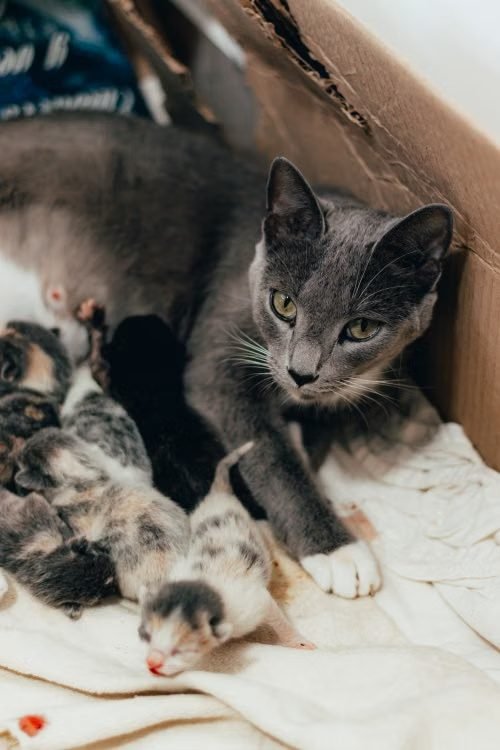
Choose a quiet room kept at around 22°C and give the queen a box big enough to stand, stretch and turn around in. A large cardboard box works. Line it with absorbent bedding and pick sides high enough to stop crawling newborns climbing out [6].
Newborn kittens cannot regulate their own body temperature, so they depend on their mother and their surroundings for warmth. International Cat Care gives a target of 29 to 32°C inside the kitten box in the first week, falling to around 27°C by 7 to 10 days and 22 to 25°C by the end of the first month. Any extra heat source must leave the kittens room to move away from it [2]. Kittens can regulate their own temperature by 7 to 8 weeks [1].
Keep the bedding clean and dry, the room quiet, and other pets and family members away [5]. Checking the litter every few hours from a distance is enough to confirm the kittens are warm and feeding [5][7]. A kitten that feels cold needs a vet, because a kitten that stops suckling loses heat quickly and can develop low blood sugar [1][2].
The first 24 hours: colostrum
Colostrum is the first milk. The queen produces it for the first 2 days, and it carries antibodies that protect kittens from common diseases while their own immunity develops [1]. Kittens should suckle within 2 hours of birth and can only absorb those antibodies during the first 16 to 24 hours [2][3].
If a kitten has not latched after half an hour, gently guide it to a teat [5]. Tell your vet if any kitten has missed the first milk [3].
Feeding, sleep and weight: how to tell they are getting enough
Newborn kittens feed every 2 to 3 hours [3]. Healthy kittens eat or sleep for about 90% of their first 2 weeks, and well-fed ones have round bellies and look content [1]. A queen produces around 125ml of milk a day. A kitten short of milk cries and keeps searching for a teat [1][3].
Weight shows whether milk intake is enough. International Cat Care recommends weighing each kitten at birth, daily for the first week, then at least twice a week until weaning [2]. Birth weight is 90 to 110g. A kitten can lose up to 10% in the first 24 hours, then should gain 10 to 15g a day (5 to 10% of body weight) and double its birth weight by 1 to 2 weeks [2][3]. Kittens under 75g at birth face a higher risk of dying, and any weight loss or lack of gain needs a vet [2].
Some queens cannot feed every kitten. Your vet may then advise supplementary feeding or full hand rearing, which is a separate round-the-clock routine.
Week by week: weight and development
The weights below are approximate averages. Eye opening varies: International Cat Care gives 2 to 16 days, commonly 7 to 10, and Cats Protection gives 5 to 14 [1][4].
| Age | Typical weight | What you will see |
|---|---|---|
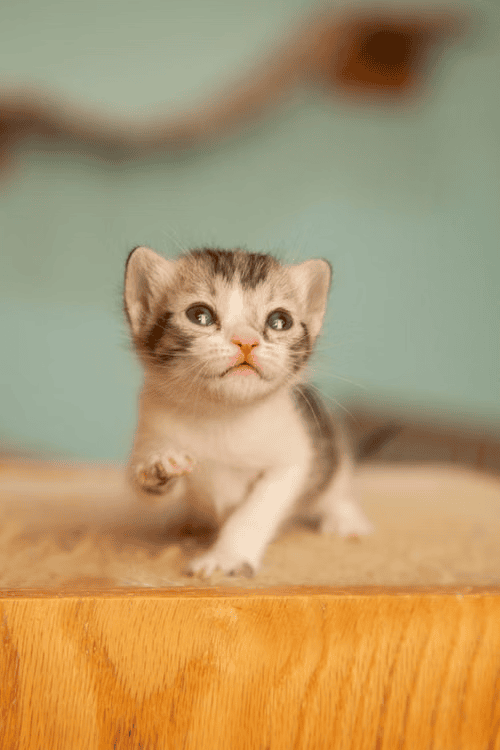
| Newborn | 90–110g | Eyes closed, ears folded, cannot stand. Slow paddling movements. Responds to warmth, touch and smell. The umbilical cord falls off by day 3. The mother licks each kitten to make it toilet. |
| 1 week | About 200g | Little movement and eyes still closed. Toileting still needs the mother’s help. |
| 2 weeks | About 300g | Eyes and ears open, teething starts, first wobbly steps and early play with littermates. |
| 3 weeks | About 400g | Ears point upwards and walking steadies. Kittens use sight to find their mother and begin to toilet alone, so a litter tray can go in. |
| 4 weeks | About 500g | Solid food can start. Kittens walk, run and play with each other. |
| 5 weeks | About 600g | Eye colour starts to change. Kittens stalk, pounce and groom themselves and each other. |
| 6 weeks | About 700g | Playful, grooming well and toileting without the mother’s help. Weaning is well under way. |
| 7 weeks | About 800g | Weaning almost complete and eye colour settled. Kittens can now regulate their own body temperature. |
| 8 weeks | About 900g | First vaccinations due. Time to discuss neutering and microchipping with the vet. |
Healthy litter or fading kitten?
Healthy kittens cuddle together and sleep contentedly between feeds. A sick kitten often lies apart from the litter, is restless, will not suckle, cries a lot, or is weak, cold or regurgitating milk. Its mother may ignore it [1][2].
Newborns have almost no energy reserves and hold more water than adult cats, so three problems develop fast: hypothermia (low body temperature), hypoglycaemia (low blood sugar) and dehydration [2]. Vets call kittens that die between birth and weaning “fading kittens”. Most kitten deaths happen before birth or in the first week, and the risk falls sharply after that. In some breeds, blood group incompatibility between queen and kitten (neonatal isoerythrolysis) is one cause [2].
Contact your vet as soon as possible if a kitten:
- cries excessively or will not suckle
- is weak, cold or regurgitating milk
- lies apart from the litter or is ignored by its mother
- loses weight or stops gaining [1][2]
Kittens can go downhill very quickly, so waiting to see if a problem passes carries risk [1]. Call the vet straight away if the queen has:
- bleeding from the vagina or unusual discharge
- a prolapsed uterus
- mastitis (a hot, painful, swollen mammary gland)
- poor appetite, excessive drinking or vomiting
- clumsy movement, twitching or collapse [5]
If the mother is missing or you find kittens outdoors
If the queen has died, is too ill to nurse or rejects the litter, the kittens need total replacement feeding, and your vet can advise on it [1].
Kittens found outdoors are a separate case. The mother is often close by. The US charity Alley Cat Allies advises against picking them up, and suggests watching from a distance, out of sight, for several hours to see whether she returns. Call a vet at once if the mother or kittens look ill or injured [9].
How the queen behaves and when to handle the kittens
Most cats take to mothering naturally. Expect licking, nuzzling and purring, and a mother who prefers you to keep your distance at first. That settles within a few weeks [5].
Avoid touching newborns if you can. Handling too much can lead her to reject them, and it can cut into feeding time [2][5]. Severe or repeated disturbance is riskier, because a nervous queen may harm her kittens. The risk falls when she is healthy and settled in quiet, familiar surroundings [2][5]. Weighing is the main reason to handle newborns, and only if she is relaxed [3].
From 2 weeks, gentle handling can begin if she allows it. How kittens are brought up in their first 7 to 8 weeks shapes how they behave around people for life [1][5].
Looking after the queen
Milk production demands a lot of energy, and poor nutrition lowers milk quality. International Cat Care advises a high-quality commercial cat food, and Cats Protection recommends kitten food, which is higher in calories, fat and protein and easy to digest [2][5].
Keep her indoors. An unneutered queen can become pregnant again 1 to 2 weeks after giving birth [3][5]. Neutering can happen while she is still feeding, but Cats Protection suggests waiting until the kittens are around 8 weeks old and weaned [3][5]. The kittens themselves are neutered at around 4 months [1][6].
Weaning and the litter tray
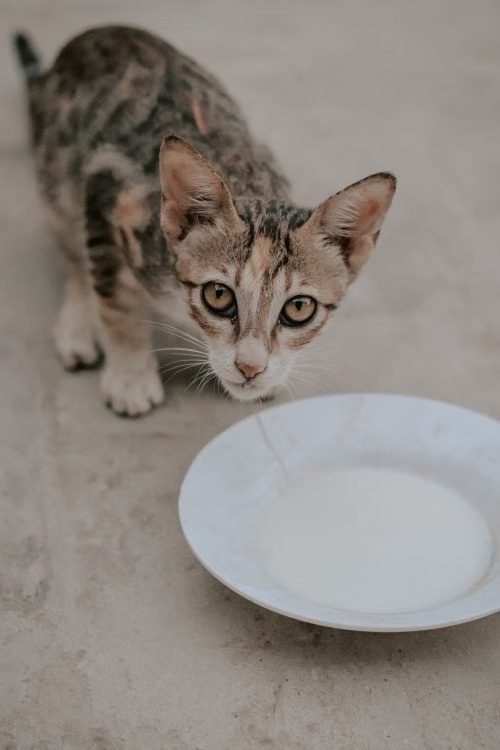
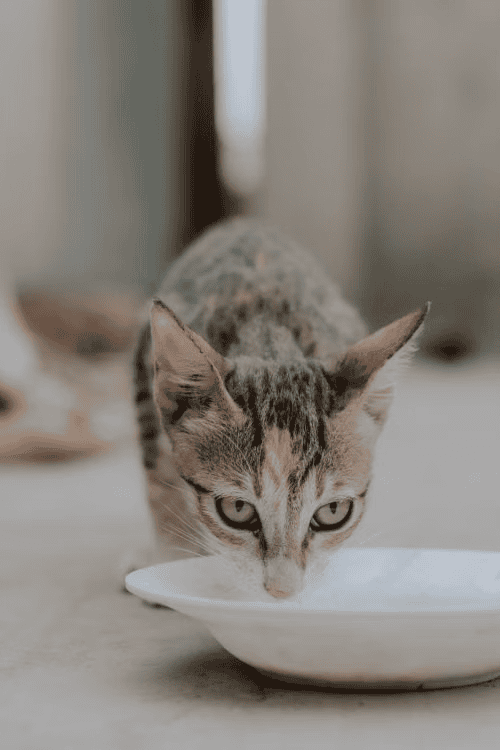
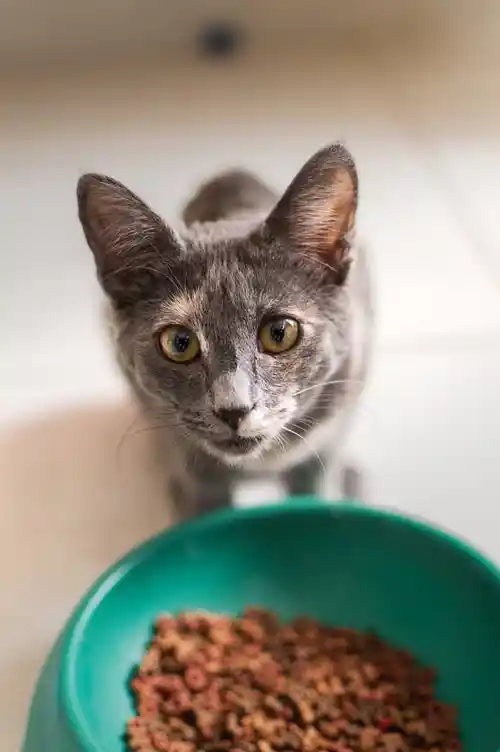
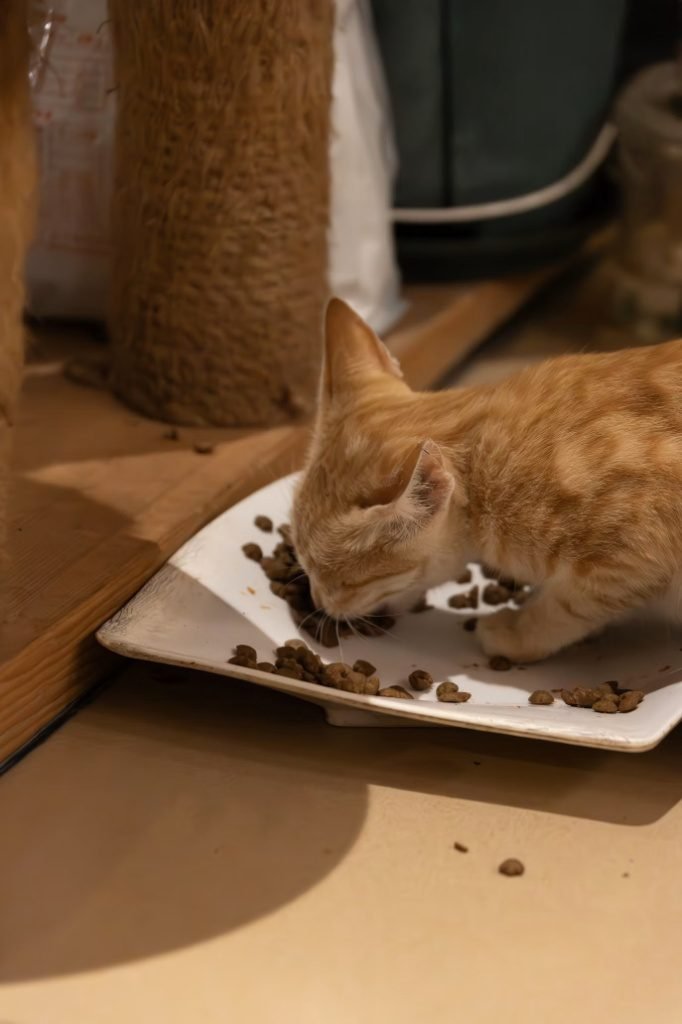
Weaning starts at 3 to 4 weeks. Starting earlier, or going too fast, stresses both mother and kittens [1]. Offer wet kitten food, or dry kitten food moistened with water or kitten milk, on a very shallow saucer. Feed small amounts at least 4 times a day, or leave food down all day [1]. Cats Protection suggests starting with diluted kitten milk in a shallow bowl and adding wet food gradually over 3 to 4 weeks [3]. Do not use milk from the fridge at this stage, and check what happens when kittens drink cow’s milk to protect their digestion.
Kittens are fully weaned by 6 to 8 weeks. They need a food made for their age, because adult food lacks nutrients for growth, and milk replacer is not needed once they eat kitten food [1]. The article on feeding a 4 week old kitten covers this stage in detail.
Provide a low-sided litter tray from around 3 weeks. Use sand, wood or paper-based litter, since some kittens try to eat clay, and avoid silica gel under 8 weeks. A little soiled litter left in the tray acts as a scent reminder [1].
Worming, vaccination and microchipping
Kittens should be treated for worms from 3 to 6 weeks, and your vet may advise flea and worming treatment from as young as 2 days depending on the risk to the litter [1][3].
Protection from colostrum fades before vaccines take over, which leaves a gap. Vaccinations start at 8 to 9 weeks [1][2][3]. The first course covers feline herpesvirus, feline parvovirus and feline calicivirus [4].
Microchipping is compulsory for cats in England. Since 10 June 2024 an owned cat must be microchipped by 20 weeks, including indoor cats, and owners can be fined up to £500. There is no minimum age [8].
When kittens can leave their mother
Kittens should stay with their mother until at least 8 weeks, and 8 to 9 weeks is better [5]. Leaving earlier can cause behavioural problems, such as kneading and suckling that carry on into adulthood [3].
Once the kittens are fully weaned, let the queen spend more time apart from them each day so her milk dries up gradually [3]. After that, the kitten feeding pillar takes over.
Questions carers often ask
Why is my cat moving her kittens?
A mother cat may move her kittens if she feels unsafe or the nest is not warm enough. Do not stop her. Provide a quiet, warm space where she chooses to settle.
When do newborn kittens open their eyes?
Anywhere from 2 to 16 days, commonly 7 to 10 days. Ears are open by 2 weeks and point upwards by 3 weeks. Eye colour starts to change from baby blue at around 5 weeks and has settled by 7 weeks.
Can other pets meet newborn kittens?
Keep other pets away from the queen and kittens in the early weeks. She is protective, and the room should stay quiet so she can settle into caring for the litter.
- International Cat Care, “Bringing up a litter of kittens: health considerations”
- International Cat Care, “Fading kittens”
- Cats Protection, “Kitten care”
- Cats Protection, “Kitten ageing chart”
- Cats Protection, “After birth”
- PDSA, “Cat labour: a guide to your cat giving birth”
- VCA Animal Hospitals, “Raising kittens”
- BSAVA, “Cat microchipping is now mandatory”
- Alley Cat Allies, “Found kittens: Leave Them Be”