How to Hand Reared Kittens: Feeding, Warmth and Care by Week
Last updated 26 September 2026 · Fact-checked against current guidance from International Cat Care, PDSA, Cats Protection and CAT 77
Quick answer
A hand reared kitten needs feeding every 2 hours around the clock for the first 2 to 3 weeks, kept at 29–32°C, and stimulated to toilet after every feed. Full weaning onto solid food is usually complete by 6 to 7 weeks. Speak to a vet before you start, and never use cow’s or goat’s milk.
Hand reared a kitten means taking over everything its mother would normally do: feeding, warmth, toileting and cleaning, around the clock, until the kitten is weaned onto solid food at around 6 to 7 weeks old. It’s demanding. Newborn kittens need feeding as often as every two hours, day and night, for the first two to three weeks [1][2].
This article covers what to check before you start, the equipment you need, how to feed and warm a kitten safely, and when a vet needs to get involved. Speak to a vet before you begin, especially if you’ve found the kittens rather than bred them, since they can check the kittens over and confirm the right milk replacer and feeding amounts for their size [1].
When kittens actually need hand rearing
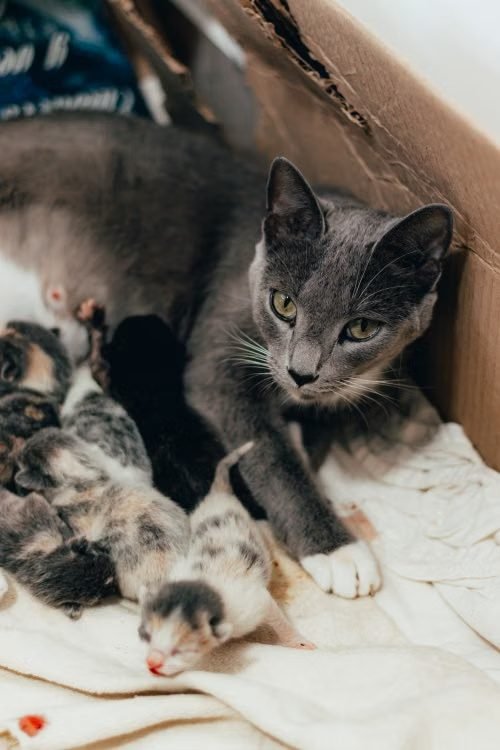
Most kittens get everything they need from their mother. She feeds them, keeps them warm, licks them clean and stimulates them to go to the toilet. Hand rearing becomes necessary when she can’t do this: if she’s ill, has died, has rejected part or all of the litter, or has a litter too large for her to feed [1][3].
Before assuming you need to hand rear from scratch, check two things.
First, whether the mother is present but simply not producing enough milk. You can check this by gently massaging around a teat between thumb and forefinger. A creamy discharge is colostrum, a translucent white fluid is milk, and neither means that teat isn’t yet producing [4].
Second, whether the kittens need full replacement feeding or just a top-up alongside the mother. If she’s coping with most of the litter and struggling with one or two kittens, supplemental feeding two or three times a day may be enough rather than taking over completely [3].
If you’ve found kittens without a mother present, contact a local cat rescue such as Cats Protection or a vet practice. They may be able to match the litter with a lactating foster queen, which gives kittens a better start than a bottle where one is available [3].
What you need before the first feed
Gather everything before you bring a kitten home, because the first feed can’t wait:
- A proper kitten milk replacer (KMR), from a vet practice or pet shop
- A kitten feeding bottle with a small teat, or 1ml to 2ml syringes for very small or weak kittens
- Sterilising tablets or solution, the same type used for human baby bottles
- A digital kitchen or baby scale, accurate to at least 1 gram
- A covered heat pad, microwave heat pad or well-wrapped hot water bottle
- A small cat carrier or box with soft bedding for the first three weeks
- Cotton wool or fragrance-free wet wipes for toileting
- A notebook or spreadsheet to log weight, feeds and toileting for each kitten
Never use for kitten cow’s milk, goat’s milk, or supermarket kitten and puppy milk. Cow’s and goat’s milk don’t contain enough protein or fat for a kitten’s needs and typically cause diarrhoea. Only a properly formulated kitten milk replacer is suitable [1][2].
Keeping a kitten warm
Newborn a kittens can’t shiver or regulate their own body temperature, so without a mother’s body heat they get cold quickly. This matters more than most new carers expect: a cold kitten won’t feed properly, and feeding a cold kitten risks aspiration, because a weak kitten can’t suckle and swallow safely [1][4].
Cover a heat pad or hot water bottle with bedding rather than letting the kitten lie directly on it, and make the nesting area large enough that the kitten can move away from the heat if it gets too warm. Reduce the temperature gradually as the kittens grow:
| Age | Target temperature |
|---|---|
| Birth to 7–10 days | 29–32°C |
| 7–10 days to 4 weeks | Gradually down to 26.7°C, then towards 22°C by the end of the first month |
| 4–6 weeks | Reducing further towards normal room temperature, around 21°C |
Feeding a hand reared kitten
Make up the milk replacer exactly as the packaging instructs. Water that’s too hot or too cold when mixed with the powder causes clumps, which are a common cause of constipation in bottle-fed kittens [2]. Warm the made-up milk to around 35–38°C and test it on the inside of your wrist before every feed. You shouldn’t be able to feel it as hot or cold [1][4].
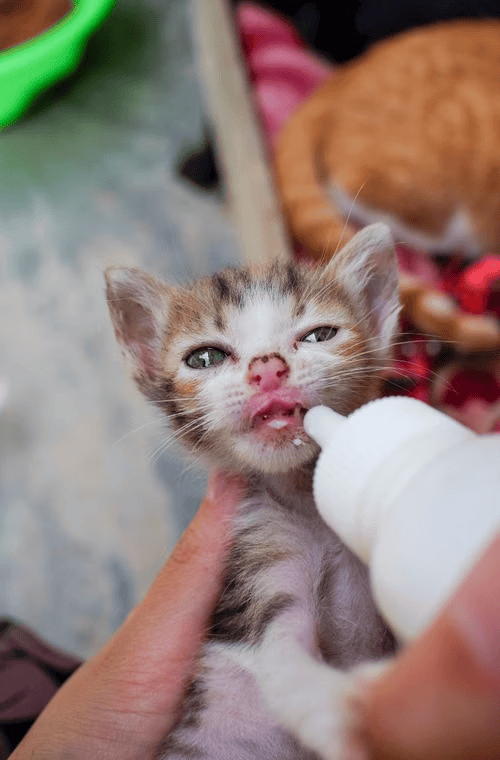
Feed the kitten lying on its front, with all four paws on a surface, the same position it would take at its mother’s teat. Never feed a kitten on its back: this increases the risk of milk going into the lungs instead of the stomach [1][2].
Offer the teat and let the kitten set the pace. A kitten will pull away when it’s full, and forcing more milk in is one of the main causes of aspiration. If you see bubbles of milk at the kitten’s nose, stop immediately, wipe it clean, and wait until breathing settles before trying again, more slowly and in the correct position [2].
If a kitten is too weak to suck from a bottle, a syringe can be used instead, dripping small amounts onto the tongue and letting the kitten swallow at its own pace. Syringe feeding carries a higher aspiration risk because you control the flow rather than the kitten, so it’s usually a short-term step until the kitten is strong enough to bottle-feed [2][4].
Feeding schedule by age
Milk replacer packaging gives a daily total, split across the feeds below. Treat the amounts as a starting point and adjust to appetite: a kitten that pulls away full is done, and one that’s still rooting after a feed may need slightly more next time [4].
| Age | Feeds per 24 hours | Approximate interval | What’s happening |
|---|---|---|---|
| 0–2 weeks | 8–10 | Every 2–2.5 hours, including overnight | Milk only |
| 2–3 weeks | 6–7 | Every 2.5–3.5 hours | Milk only; eyes open; toileting stimulation still needed |
| 3–4 weeks | 6–7 | Every 3 hours | Milk continues; introduce shallow dish of milk and start worming |
| 4–5 weeks | 5 | Every 3.5–5 hours | Wet or moistened food introduced alongside milk feeds |
| 5–6 weeks | Milk as top-up only | As needed | Mostly eating solid food, water available |
| 6–7 weeks | Fully weaned | — | No more bottle feeds |
Helping kittens go to the toilet
Kittens under about three weeks old can’t urinate or defecate on their own. Normally, their mother triggers this by licking their anogenital area, and you need to replicate it. After every feed, gently wipe under the tail with warm, damp cotton wool or a fragrance-free wet wipe until the kitten passes urine and, less often, faeces, then dry the area [1][3].
From around 3 weeks, kittens start to manage this reflex themselves. Placing them on a litter tray with a small amount of used litter left in it helps them learn where to go [1].
Weighing and tracking growth
Weigh each kitten at birth and at the same time every day after that, using clean kitchen scales. Neonatal development usually weigh around 100 grams and should gain roughly 5–10% of their body weight each day over the first two weeks, doubling their birth weight by 7–10 days [3][4]. A kitten that loses weight, or isn’t keeping pace with its littermates, needs a vet’s attention rather than a wait-and-see approach.
Keep a simple log per kitten: date, weight, number of feeds, and anything unusual. This is the fastest way to catch a problem before a kitten becomes seriously unwell, since kittens can decline very quickly.
Weaning onto solid food
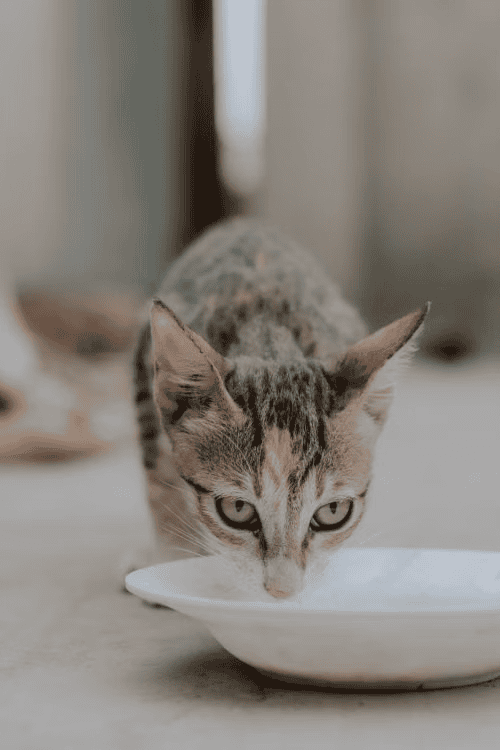
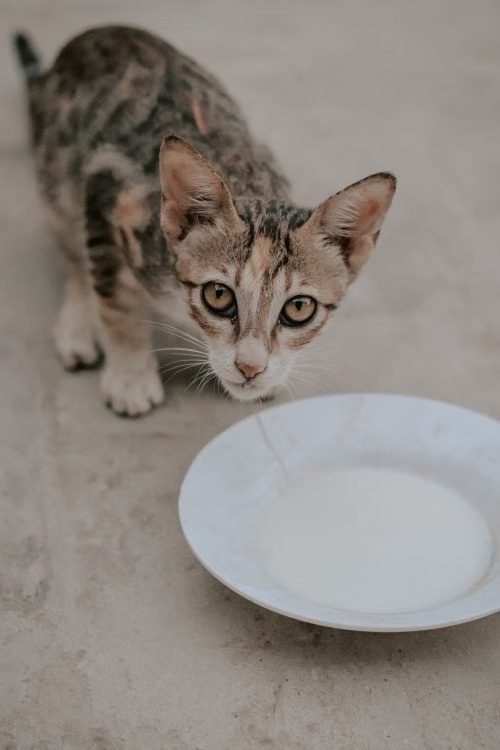
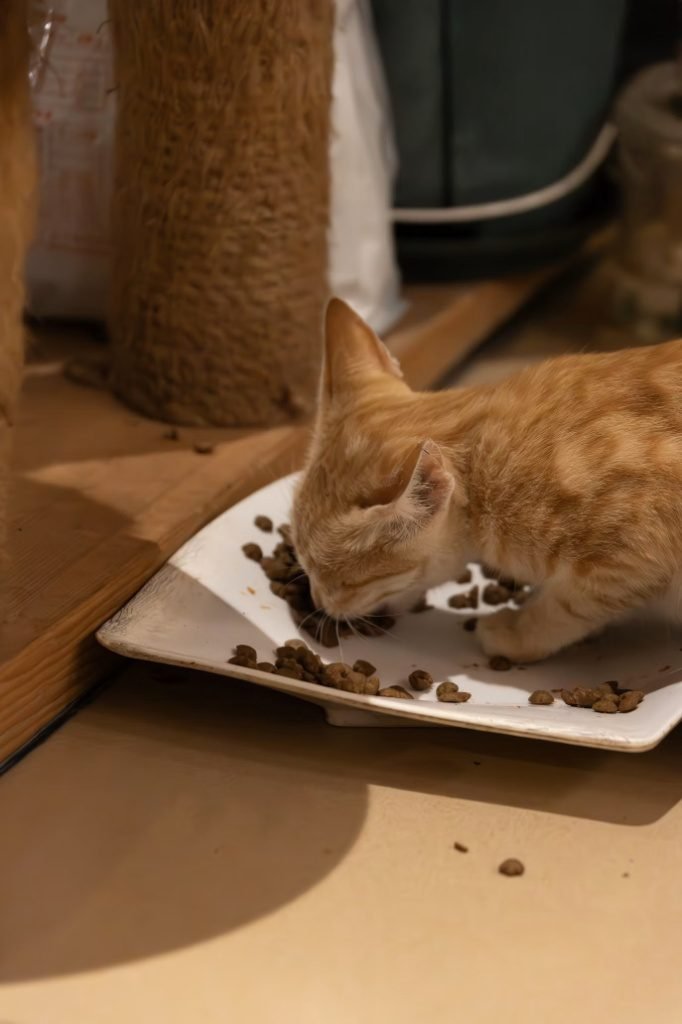
Weaning starts at around 3 to 4 weeks old and should be gradual. Doing it too fast, or too late, is linked to digestive upset and weight loss in hand-reared kittens [3]. Start by offering the usual milk replacer in a shallow dish rather than a bottle. Once the kitten is confident drinking from the dish, mix a small amount of wet or moistened dry kitten food with milk replacer to make a soft, sloppy paste, and offer it in a shallow bowl at ground level.
Gradually reduce the amount of milk mixed in and increase the proportion of solid food over the following one to two weeks. By 6 to 7 weeks, most kittens are eating kitten food and drinking water without any bottle feeds [1][2]. Never force feed solid food. A kitten that resists shouldn’t be pushed, since this carries the same aspiration risk as forcing milk.
Hygiene and infection risk
Hand-reared kittens miss out on the antibodies passed through their mother’s colostrum in the first hours of life, which makes them more vulnerable to infection than kittens raised by a queen [3]. Wash and sterilise bottles, teats and syringes after every feed, using the same sterilising tablets or solution sold for human baby equipment. Wipe away spilled milk straight after feeds, and clean bedding and the nesting area daily.
Common problems and when to call a vet
Contact a vet straight away if a kitten shows any of the following: diarrhoea, ongoing constipation, low energy or weakness, twitching, not feeding, not passing urine or faeces, or feels cold to the touch [3]. A kitten that cries excessively or won’t suck is usually either unwell or not getting enough milk, and kittens can deteriorate within hours, so this isn’t a wait-and-see situation [1].
A few problems come up often enough to explain in more detail:
Constipation. Usually caused by clumps in the milk replacer from water mixed at the wrong temperature. If caught early, a vet may suggest replacing one feed with cooled boiled water rather than milk, but persistent constipation needs a vet visit [3].
Weakness or low blood sugar. A weak, floppy or unresponsive kitten needs an emergency vet appointment. Low blood sugar (hypoglycaemia) can develop quickly in a kitten that isn’t feeding properly and can be fatal if untreated.
Milk coming from the nose during feeding. This means milk has gone into the airway rather than the stomach. Stop the feed immediately, hold the kitten with its head slightly lower than its body, and get veterinary advice if breathing doesn’t settle quickly.
If you’re worried about one kitten in a litter, take the whole litter to the vet together rather than separating the unwell one. Separation from littermates is stressful and isn’t necessary for an examination.
Socialisation and development
Research suggests that hand-reared kittens tend to be more nervous than kittens raised by their mother, and that rushed or poorly managed weaning is linked to increased aggression and digestive problems [3]. Keeping littermates together where possible, rather than hand rearing a single kitten alone, appears to support more typical social development, since kittens learn bite inhibition and normal play boundaries from each other [3].
The socialisation period for kittens runs from roughly 2 to 7 weeks old, so gentle, positive handling should start early, in short sessions several times a day. Introducing kittens to different people, calmly and gradually, during this window matters for how relaxed they’ll be as adult cats [3].
Worming and vaccination
Hand-reared kittens follow the same preventative health schedule as any other kitten. Worming usually starts at around 3 weeks old, using a product and dose recommended by a vet based on the kitten’s current weight [3]. Vaccinations typically begin at 8 to 9 weeks, with a booster a few weeks later [3][5]. Because orphaned kittens may have had little or no colostrum, and therefore fewer maternal antibodies, a vet may suggest starting vaccinations slightly earlier. This is a decision for a vet, not a fixed rule.
Questions carers often ask
Can another lactating cat feed orphaned kittens?
Yes, if one is available. A foster queen who is already nursing her own litter, or has recently lost one, can sometimes take on extra kittens. This is usually arranged through a vet or a cat rescue such as Cats Protection, and it tends to produce better outcomes than full hand-rearing where it’s possible .
Is it harder to hand rear a single kitten than a litter?
It’s not harder in terms of feeding, but a lone kitten misses the play and feeding cues it would normally get from littermates. Where possible, pairing an orphaned singleton with a similarly aged kitten, once both are healthy, can help with normal social development .
How long does the whole process take?
From birth to full weaning is typically 6 to 7 weeks, with the most intensive feeding schedule (overnight feeds every two hours) limited to roughly the first three weeks .
Do hand-reared kittens need anything different from kittens raised by their mother once weaned?
No. Once a kitten is eating solid food and drinking water independently, its ongoing feeding and care needs are the same as any other kitten of the same age.
- International Cat Care, “Hand-rearing kittens”
- PDSA, “Hand rearing kittens”
- Cats Protection and International Cat Care behavioural findings on hand-rearing and socialisation, referenced in [1]
- CAT 77, “Hand-rearing Kittens”
- Vet Verified, “Hand Rearing Kittens: A Complete Guide for Cat Owners”