
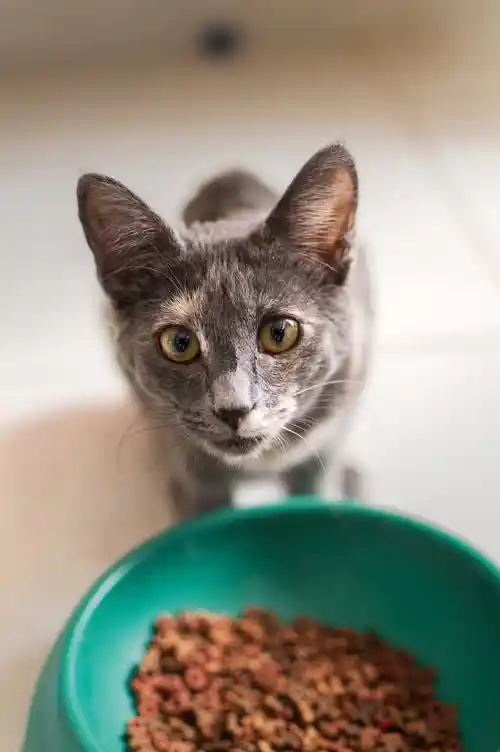
How Much to Feed a Kitten: Age & Weight Chart (UK)
Last Updated: September 2026
Working out how much to feed a kitten isn’t always straightforward, since pet food packaging often lists a wide range and doesn’t always match your kitten’s actual age or weight. It’s easy to end up either underfeeding a kitten who’s growing fast or overfeeding one who’s already a little rounder than they should be.
This article breaks kitten feeding down by age and weight, explains the difference between feeding wet food, dry food and a mix of both, and covers how to tell if your kitten is getting the right amount. The aim is to give you a practical starting point you can adjust as your kitten grows, not a single number that’s supposed to fit every cat.
Quick Answer
How much to feed a kitten depends mainly on age, weight and the calorie content of the food. As a general rule, kittens need roughly 2 to 3 times more energy per kilogram of body weight than an adult cat, split across three to four small meals a day up to six months old, then tapering to two meals as they approach adulthood. Always check the feeding guide on the specific food you’re using, since caloric density varies between brands. On average, a growing kitten’s daily intake progresses from around 130 kcal/day at 4–8 weeks up to 300 kcal/day during peak growth months.
Kitten Feeding Chart by Age & Weight
There’s no single portion size that works across every kitten food, because the calorie density of dry kibble, wet pouches and canned food all differ. What stays consistent is the general daily calorie need, which food manufacturers use to calculate their own feeding guides.
The chart below gives typical daily calorie ranges by age and approximate weight, based on standard growth patterns for domestic kittens. The Merck Veterinary Manual’s kitten care guidance confirms that kittens need multiple daily feedings which can be gradually decreased as they age, continuing on kitten food until adulthood around 9 to 12 months.
Use it alongside the feeding guide printed on your chosen food, not instead of it.
| Age | Typical Weight | Daily Calorie Need (approx.) | Meals Per Day |
|---|---|---|---|
| 0 to 4 weeks | 100g to 450g | Milk replacer only (KMR) | 6 to 8 feeds |
| 4 to 8 weeks | 450g to 900g | 130 to 200 kcal | 4 meals |
| 2 to 3 months | 0.9kg to 1.8kg | 180 to 250 kcal | 4 meals |
| 3 to 4 months | 1.5kg to 2.5kg | 200 to 280 kcal | 3 to 4 meals |
| 4 to 6 months | 2kg to 3.5kg | 220 to 300 kcal | 3 meals |
| 6 to 9 months | 3kg to 4.5kg | 200 to 260 kcal | 2 to 3 meals |
| 9 to 12 months | Approaching adult weight | Transitioning to adult intake | 2 meals |
These figures are a starting point, not a prescription. A kitten’s actual weight, breed, activity level and body condition should always fine-tune the amount you feed. If you’re ever unsure, your vet can calculate a more precise daily calorie target based on your kitten’s current weight.
Kitten Feeding Guidelines by Age Group
0 to 4 Weeks: Neonatal Feeding
Newborn kittens should be feeding from their mother or, if she isn’t available, a kitten milk replacer (KMR) designed specifically for cats. Cow’s milk is not suitable, since it lacks the right balance of nutrients and can cause digestive upset. At this stage, kittens typically need small, frequent feeds roughly every two to three hours, since their stomach capacity is tiny.
If you’re hand-rearing an orphaned kitten, this is a situation where professional guidance matters. A vet or an experienced rescue organisation can advise on the correct volume and feeding frequency based on daily weight checks, since underfeeding at this stage is a genuine welfare risk.
4 to 8 Weeks: Weaning
Weaning usually begins around four weeks old, when kittens start showing interest in solid food alongside milk. A weaning slurry, made by mixing wet kitten food or moistened kibble with warm water or milk replacer, helps bridge the gap between nursing and solid meals. Kittens are typically fully weaned onto solid kitten food by around eight weeks.
This is also when deciduous teeth (the kitten’s baby teeth) start coming through, which is part of why very young kittens manage soft, mushy textures more easily than dry kibble.
2 to 4 Months: Peak Growth
This period involves some of the fastest growth a kitten will go through, so calorie needs per kilogram of body weight stay high. Four meals a day is typical here, since a kitten’s stomach capacity is still small relative to how much energy it needs. Free feeding dry kibble can work for some kittens during this stage, but it’s worth monitoring intake so you know roughly how much they’re eating.
4 to 6 Months: Continued Growth and Teething
Permanent teeth start replacing deciduous teeth from around four months, which occasionally causes a temporary dip in appetite or a preference for softer food. Meals can typically reduce to three a day. This is also a sensible point to start paying closer attention to body condition, since growth rate can vary noticeably between individual kittens even of the same breed.
6 to 12 Months: Approaching Adulthood
Growth slows from around six months onward, though smaller breeds may reach adult size sooner than larger ones. Meals can generally move to two a day, and portion sizes should be adjusted down gradually rather than switched abruptly to adult amounts. Most vets recommend transitioning fully to adult cat food somewhere between 10 and 12 months, though some larger breeds benefit from staying on kitten food slightly longer.
How Much Wet Food to Feed a Kitten
Wet food, whether in canned or pouch form, typically has a lower caloric density than dry kibble because of its higher moisture content, often 70 to 80 percent water compared with around 10 percent in dry food. This means kittens usually need to eat a larger volume of wet food to meet the same calorie target as dry food.
As a rough guide, a kitten around 8 to 12 weeks old eating only wet food may need somewhere between 150g and 250g spread across four meals, depending on the specific product’s calorie content per 100g. Always check the packaging, since this can vary considerably between brands and recipes.
Wet food has a genuine practical advantage for hydration, since kittens fed primarily dry food sometimes don’t drink enough water to compensate for the lower moisture content of kibble.
Canned wet food in particular can help support adequate hydration, which matters for kidney and urinary tract health later in life. As the Cornell Feline Health Center notes, cats that eat wet food, which can contain up to 80% water, often end up drinking less overall meaning the food itself does much of the hydration work.
How Much Dry Food to Feed a Kitten
Dry kibble is calorie-dense, so portions look small compared with wet food. A kitten around three months old might only need 40g to 55g of dry kitten food a day, split across three or four meals, though this depends heavily on the specific product’s caloric density, which is usually listed as kcal per 100g on the packaging.
Because dry food is easy to leave out, some owners free-feed it rather than measuring meals. This can work reasonably well for kittens with a naturally moderate appetite, but it makes it harder to notice if intake drops or increases significantly, which is often an early sign something needs attention. Measuring dry food with a gram scale rather than a measuring cup gives a more accurate daily total, since cup measurements can vary by how tightly the kibble is packed.
Mixing Wet and Dry Food: How to Get the Balance Right
Feeding a mix of wet and dry food is a great practice that provides both hydration benefits from wet food and dental texture from dry kibble. The main key is calculating the combined calorie total rather than serving full portions of both as separate meals.
Here is how to combine wet and dry food safely:
- Split Daily Calories: Decide what proportion of daily calories will come from wet food and dry food, then measure each portion against that split to avoid accidental overfeeding.
- Practical Example: A kitten needing 220 kcal a day might get 130 kcal from wet food (split between morning and evening) and 90 kcal from dry kibble left out during the day.
- Weigh Portions Accurately: Use a digital kitchen gram scale for dry kibble rather than measuring cups to ensure precise daily caloric intake.
- Check Brand Guidelines: Popular ranges such as Royal Canin Kitten and Whiskas Kitten feature specific mixed-feeding charts directly on their packaging to simplify portioning.
How Often Should You Feed a Kitten
Kittens generally need more frequent, smaller meals than adult cats because of their limited stomach capacity relative to their energy needs. A rough schedule looks like this.
- 6 to 12 weeks old: four meals a day
- 3 to 6 months old: three meals a day
- 6 to 12 months old: two to three meals a day
- From 12 months: two meals a day is typical for most adult cats
Scheduled meal feeding, rather than free feeding, gives you a clearer picture of how much your kitten is actually eating and makes it easier to spot changes in appetite early. Free feeding can suit some kittens, particularly with dry food, but it’s worth weighing your kitten regularly if you choose this approach so reduced or increased intake doesn’t go unnoticed.
What Affects How Much Your Kitten Eats
Feeding charts assume an average kitten, but several factors can shift how much an individual kitten actually needs.
Breed and expected adult size. Larger breeds such as Maine Coons grow for longer and may need proportionally more food for a longer period than smaller breeds that mature earlier.
Activity level. A highly active kitten burns more energy than one that sleeps for most of the day, which is fairly normal for young kittens anyway given how much energy sleep and rapid growth both require.
Neutering status. Neutering, which is commonly carried out from around four months old in the UK, can reduce a cat’s metabolic rate slightly, meaning portions sometimes need a small downward adjustment afterwards.
Illness or parasites. Intestinal worms are common in kittens and can affect appetite and weight gain even when feeding amounts are correct, which is part of why regular worming according to veterinary advice matters alongside diet.
Food palatability and texture. Kittens going through teething sometimes prefer softer textures temporarily, and appetite can dip briefly without it indicating an underlying problem.
Is Your Kitten Getting Enough Food?
Signs of Underfeeding
- Visible waist that’s too pronounced
- Ribs that are easy to see rather than just easy to feel
- Low energy
- Slower than expected weight gain over consecutive weekly weighings
- Persistent hunger behaviour, such as crying at mealtimes or scavenging
Signs of Overfeeding
- Rounded abdomen that doesn’t taper into a visible waist from above
- Difficulty feeling the ribs under a light layer of fat
- Weight gain that consistently outpaces the expected growth curve for the kitten’s age and breed
- Overfeeding is arguably more common than underfeeding in kittens fed ad-lib dry food
Using a Body Condition Score
- Vets commonly use a Body Condition Score (BCS), usually on a nine-point scale, based on how easily the ribs, waist and abdomen can be felt and seen
- More reliable than weight alone, since ideal weight varies significantly between breeds
- Most UK vet practices will check body condition at a routine appointment, and many offer free weight clinics for this exact purpose
Underfeeding vs Overfeeding at a Glance
Use this quick comparison table to identify physical and behavioural indicators that signal whether your kitten’s daily portion needs adjusting:
| Sign | Underfeeding | Overfeeding |
|---|---|---|
| Ribs | Easy to see | Hard to feel under fat layer |
| Waistline | Too pronounced / hollow | No tapering, rounded abdomen |
| Energy Level | Lethargic / low energy | Usually normal to high |
| Weight Gain | Slower than expected | Excessive / rapid growth curve |
| Behaviour | Vocal at mealtimes, scavenging | No consistent behavioural change |
Mistakes to Avoid When Feeding a Kitten
Feeding adult cat food too early. Adult cat food doesn’t provide the higher protein and calorie density kittens need to support growth, and switching too soon can leave a kitten under-nourished during a critical growth period.
As PDSA’s kitten care guidance confirms, young kittens need a good quality, commercially available, complete food designed specifically for kittens.
Guessing portions instead of checking the packaging. Caloric density varies enough between products that a portion size that’s correct for one brand can be significantly wrong for another.
Free feeding without monitoring weight. Free feeding isn’t inherently a problem, but doing it without occasional weight checks makes it easy to miss gradual overfeeding.
Feeding cow’s milk. Cow’s milk isn’t formulated for kittens and commonly causes digestive upset; it should be avoided in favour of water or a kitten-specific milk replacer where milk is genuinely needed.
Changing food abruptly. Sudden diet changes, including the transition from kitten to adult food, are more likely to cause digestive upset than a gradual transition over seven to ten days.
Myth vs Fact: Kitten Feeding Myths Cleared Up
Myth: Kittens should always have food available to prevent them going hungry.
Fact: Constant free access to food particularly calorie-dense dry kibble removes natural hunger and fullness cues, making it a primary contributor to early weight gain.
Myth: A chubby kitten is a healthy kitten.
Fact: Excess weight during early growth stages increases the risk of lifelong adult obesity; visible extra fat is not a reliable sign of optimal health.
Myth: Wet food and dry food must be served as separate full standalone meals.
Fact: Both can be combined into the same daily caloric budget by scaling down each portion so their combined energy total perfectly matches your kitten’s requirements.
Vet-Backed Tips for Feeding Your Kitten
- Weigh your kitten weekly during the first six months and keep a simple log, since steady, gradual weight gain is a better indicator of correct feeding than any single measurement.
- Use a gram scale rather than a measuring cup for dry food, since cup measurements are a common source of inaccurate portioning.
- Introduce any new food gradually over seven to ten days, mixing increasing amounts of the new food with the old to reduce the chance of digestive upset.
- If your kitten seems constantly hungry despite eating the recommended amount, check with your vet before simply increasing portions, since this can occasionally indicate an underlying issue such as parasites.
- Keep fresh water available at all times, particularly if your kitten eats mainly dry food, since dry kibble’s low moisture content means they’ll rely more on drinking to stay hydrated.
Getting Kitten Feeding Right
- Kitten feeding needs change a lot across the first year frequent small meals during rapid early growth, gradually reducing toward adult portion sizes by around 10 to 12 months.
- Age and weight charts are only a starting point. The calorie content of your specific food, your kitten’s individual growth rate, and regular body condition checks matter just as much as any generic table.
- If you’re ever unsure whether your kitten’s weight gain is on track, a vet weight check is a quick and usually free way to confirm you’re feeding the right amount.
References & Scientific Standards
- World Small Animal Veterinary Association (WSAVA) – Global Nutrition Guidelines
- FEDIAF (European Pet Food Industry Federation) – Nutritional Guidelines for Complete and Complementary Pet Food
- PDSA – Kitten Care and Weaning Advice
- Royal Veterinary College – Feline Growth and Body Condition Scoring Guidance
- AAFCO (Association of American Feed Control Officials) – Pet Food Nutrient Profiles
Frequently Asked Questions About Kitten Feeding
A kitten around two months old typically needs roughly 180 to 250 kcal a day, split across four meals, though the exact grams depend on the calorie density of the specific food. Always check the feeding guide on the packaging for an accurate starting point.
At three months, most kittens need around 200 to 280 kcal a day, usually across three to four meals. This is generally one of the highest calorie-need periods relative to body weight, since growth is still rapid.
Four month old kittens typically need approximately 220 to 300 kcal a day across three meals. This stage often overlaps with teething, which can occasionally cause a short-term dip in appetite.
By six months, daily needs are usually around 200 to 260 kcal, often across two to three meals, as growth begins to slow compared with earlier months.
This depends on the calorie content of the specific product, but as a rough guide, a young kitten eating only wet food may need somewhere between 150g and 250g a day, spread across three to four meals. Check the packaging for exact figures.
Feed four times a day from weaning to around three months, then gradually reduce to three meals by six months and two meals from around a year old, adjusting based on your kitten’s individual appetite and weight.
You can, particularly with dry food, but it’s worth weighing your kitten regularly if you choose this method so any gradual over or underfeeding doesn’t go unnoticed.
