
Why Are Labradors and Golden Retrievers Always Hungry? If you’ve ever shared your home with a Labrador or Golden Retriever, you know the struggle is real. You barely put the food bowl away before they’re back, giving you “the look”—as if they haven’t eaten in days. It isn’t just the beginning, either. It’s the scavenging, the way a simple walk in the park turns into a mission to find anything remotely edible.
Most people call this “greedy dog behavior” or blame poor training. But that’s actually a big misunderstanding. If you’ve ever Googled “why is my Labrador always hungry” at 2 AM, you’re not alone—and the answer isn’t what you think. This guide is for 2026 owners who want science‑backed, vet‑friendly strategies to understand and manage that constant hunger.
The problem isn’t that these dogs want more food. It’s that their brains are genetically wired to ignore the “I’m full” signal. This is called canine hyperphagia—a breakdown in satiety signaling. Normally, when a dog’s stomach is full, the hypothalamus sends a “stop eating” signal. However, in many Labs and Goldens, we now know this is a “genetic double-whammy.” While the POMC gene was long thought to be the only culprit, recent genetic research has identified the DENND1B gene as another key player. These mutations don’t just increase hunger; research suggests they may cause these dogs to burn up to 25% fewer calories at rest. That’s why simply cutting portions often backfires, leaving both you and your dog frustrated.
The Science Behind the Never-Full Brain
If your Lab or Golden acts like they are starving 24/7, there is a real biological reason—and it starts deep within their DNA. This isn’t just a personality trait; it is a complex interaction of genetics that rewires how their body handles food and energy.
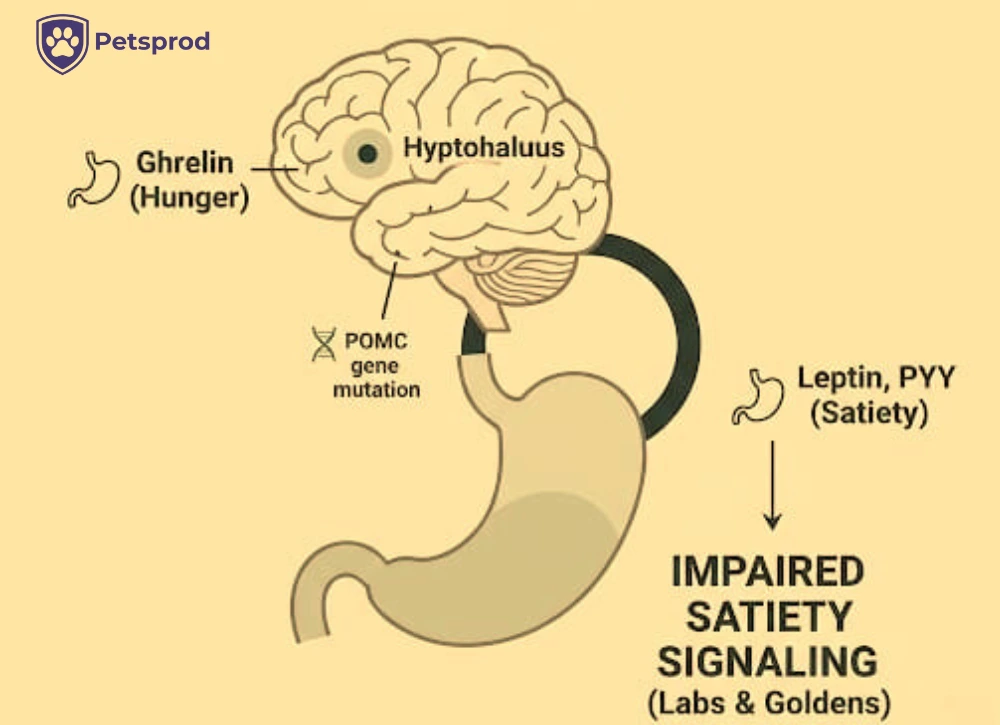
The POMC Gene Mutation: Why the Full Signal Never Arrives
There is a specific gene called POMC (pro-opiomelanocortin), and its primary job is to tell the brain, “Okay, the stomach is full—it’s time to stop eating.” It produces chemical messengers (like beta-MSH) that act as the brain’s internal “fullness” switch. In a normal dog, this system works like a charm; the stomach fills up, POMC kicks in, and the hypothalamus gets the message: “We’re good, no more food needed.”
But here is the problem—around 1 in 4 Labradors and a significant percentage of Golden Retrievers carry a mutation in this gene. When that happens, the fullness signals never reach the brain. It is like sending a text message that never delivers. Your dog’s stomach might be completely full, but their brain is sitting there thinking, “I’m still hungry. Where is the food?” This isn’t greed or a lack of discipline; it’s a documented genetic glitch in their satiety system. According to groundbreaking research from the University of Cambridge, this genetic deletion hard-wires these dogs for obesity by keeping them in a constant state of hunger. This is why many owners notice their Labrador or Golden Retriever puppies acting obsessed with food from day one; it isn’t a phase they will grow out of, but rather a fundamental part of how they are built. You can’t simply train this away—no amount of “tough love” fixes a broken gene.
Recent Discovery: The DENND1B Gene & the MC4R Pathway
For years, scientists thought the POMC gene was the only culprit. However, recent studies of canine genetic research have revealed a new player, the DENND1B gene. While POMC handles the “I’m full” signal, the DENND1B gene influences how the body stores fat through the MC4R (Melanocortin-4 receptor) pathway.
- The MC4R Connection: This pathway is the master regulator of metabolism.
- The 8% Fat Rule: Studies suggest that dogs with this genetic variant may naturally carry around 8% more body fat, regardless of how much they exercise.
This means your Retriever’s body is biologically programmed for obesity. This discovery of genetic obesity in Labradors explains why some dogs stay “thicker” even on a strict diet.
The Double-Whammy Effect: Slow Metabolism Meets High Hunger
This is where it gets tough for owners. Many Labs and Goldens suffer from a “Genetic Double-Whammy.” Their bodies are working against them in two distinct ways:
- Constant Hunger (The Signal Glitch): Because of the POMC and DENND1B mutations, their brain stays in “search mode” for food. They are hard-wired to be obsessed with treats and scavenging.
- Slow Metabolism (The Energy Glitch): Research indicates that dogs with these mutations burn 25% fewer calories at rest compared to other breeds.
What does this mean in simple terms?
Your dog feels hungrier than other dogs, but they actually need less food to survive. Their “engine” runs so efficiently that any extra calorie is immediately stored as fat rather than being burned off. This “Metabolic Glitch” is why managing a Retriever’s weight feels like an uphill battle. In puppies, this is particularly critical because overfeeding—often done by owners who think a hungry puppy needs more energy for growth—can lead to rapid weight gain that puts immediate stress on their developing joints.
Why Labs and Goldens Are More Affected Than Other Breeds
So if these hunger genes are such a problem, why do Labs and Golden Retrievers seem to get hit the hardest? And what about other retrievers—do they have the same issue?
Good questions. Let’s break it down.
Labrador vs. Golden Retriever vs. Flat-Coated Retrievers

When researchers started comparing retriever breeds, they found something interesting: Labradors top the list for POMC and DENND1B mutations, with about 25% carrying at least one of these genetic variants. Golden Retrievers come in close behind, though the percentage is slightly lower.
Flat-Coated Retrievers? They’re affected too, but not as severely. The mutation rates are lower in this breed, which might explain why you don’t hear as many Flat-Coat owners complaining about the endless begging.
But here’s the thing—it’s not just about which breed has more mutations. It’s also about how these breeds were developed in the first place.
The Hunting Dog Advantage (That Became a Problem)
Labs and Goldens were bred to be working dogs—specifically, hunting companions. Their job? Retrieve game for hours in cold water, harsh weather, and tough terrain. That kind of work requires serious energy, stamina, and most importantly, an intense food drive.
Think about it: A dog that’s naturally motivated by food is easier to train. They’ll work harder, stay focused longer, and push through exhaustion if they know a reward is coming. For hunters in the 1800s and early 1900s, a “food-obsessed” dog wasn’t a bug—it was a feature.
Over generations, breeders selected for dogs with strong appetites and high energy. They didn’t know about POMC or DENND1B genes back then, but they were unknowingly selecting for those exact traits. The dogs that were always hungry, always motivated, always ready to work? Those were the ones that got bred.
Fast forward to 2026, and most Labs and Goldens aren’t hunting anymore. They’re family pets living in apartments and suburbs. But their genetics haven’t caught up. They still have that same powerful food drive—only now, there’s no job to burn it off.
So yes, Labradors and Golden Retrievers are genetically hungrier than most breeds. And it’s not a flaw—it’s a leftover survival trait from their working dog ancestry. The problem is, modern life doesn’t give them an outlet for it.
As reported by BBC News, researchers have confirmed that this specific genetic mutation is what drives the constant search for food in Labradors and Golden Retrievers.
Managing Genetic Hunger: Vet-Backed Strategies That Actually Work
Understanding the biological drive behind your Retriever’s hunger is only the first half of the battle. While you cannot rewrite their genetic code, you can use specific, science-based methods to manage their appetite without compromising their health.
In 2026, successful weight management for Labradors and Golden Retrievers starts with precision. Because these breeds have a naturally slower metabolism, even a small mistake in their daily intake can lead to rapid weight gain.
The most effective way to manage a “never-full” brain is to ensure their base calories are strictly controlled. For a precise breakdown of daily requirements, see our guide on how much should I feed my puppy to ensure your portions match their breed’s unique metabolic needs.
Here are three science-backed strategies that vets recommend—and that real dog owners swear by.
The Volume Feeding Strategy: Fill the Bowl, Not the Calories

Before diving into how to bulk up their meals, use this quick assessment to see if your Retriever’s genetic hunger has already pushed them past a healthy weight:
Body Condition Check for Retrievers
| Body Area | Ideal Weight (Goal) | Overweight (Action Needed) |
|---|---|---|
| Ribs | Can be felt easily with a light touch | Hard to feel under a thick layer of fat |
| Waistline | Visible "tuck" behind the ribs when viewed from above | No waistline; the body looks rectangular |
| Tummy | Slants upward toward the back legs | Hangs low or looks "bulky" from the side |
| Energy | Eager to move and play | Tires quickly or pants after short walks |
Now here’s the deal dog’s: your brain is looking for two things: fullness in the stomach and satisfaction from eating. If you cut their portions down to manage weight, their stomach feels empty, and the begging gets worse.
The solution? Volume feeding.
Instead of just giving less food, you bulk up their meals with low-calorie, high-fiber ingredients that fill their stomach without packing on pounds. Think of it like adding water to soup—it looks like more, feels like more, but the calorie count stays low.
What to add:
- Green beans (fresh or frozen, no salt)
- Pumpkin (plain, not pie filling)
- Cucumber slices
- Carrots (raw or steamed)
- Zucchini
Mix these into their regular kibble. Your dog gets a full bowl, their stomach feels satisfied, and you’re not adding hundreds of extra calories. It’s a win-win.
One owner I know fills half her Lab’s bowl with steamed green beans and the other half with his regular food. He devours it like it’s a feast, and he’s about 6 pounds in three months without the constant whining.
Dopamine Over Calories: It’s Not Just About the Food
From a brain chemistry perspective, most owners don’t realize your dog isn’t just hungry for food – they’re hungry for the dopamine rush that comes with eating.
Every time your dog eats, their brain releases dopamine, the “feel-good” chemical. For Labs and Goldens with these genetic mutations, that dopamine hit is even more powerful. So when they beg, they’re not just asking for calories—they’re craving that rewarding feeling.
The good news? You can trigger that same dopamine response without overfeeding them.
How:
-
Puzzle feeders:
Hide kibble inside and make them work for it. The mental challenge + the food = double dopamine.
-
Snuffle mats:
Scatter their meal across a textured mat. They have to “hunt” for each piece, which engages their brain and slows them down.
-
Slow feeding bowls:
These maze-like bowls turn mealtime into a 10-minute activity instead of a 30-second inhale.
The result? Your dog feels mentally satisfied, not just physically full. And that makes a huge difference in curbing the constant food-seeking behavior.
The 3-Hour Hunger Rule: Timing Is Everything
Some research suggests that dogs with genetic hunger issues may feel their strongest cravings about 3 hours after a meal.
Scientists tested this with the “sausage-in-a-box” experiment. They fed the dogs a meal, then placed a box with a sausage inside in front of them at different intervals. Dogs were most obsessed with getting to that sausage around the 3-hour mark—right when their blood sugar dipped and their hunger hormones spiked.
What this means for you:
Plan your dog’s day around this cycle. If you feed breakfast at 7 AM, expect peak hunger around 10 AM. That’s not the time to leave them alone and bored—that’s when they’ll raid the trash or counter-surf.
How to use this:
- A long walk or run
- Training sessions (they’ll be super motivated)
- Play time or mental enrichment games
Basically, redirect that hunger energy into something productive. By the time they settle down, the hunger wave has passed, and they’re calm again.
If you feed twice a day, apply this rule to both meals. It’s all about staying one step ahead of their biology.
Important:
To manage these “hunger waves” effectively, you need a consistent daily routine. We recommend following a structured puppy feeding schedule by age to keep their hormones and energy levels stable throughout the day.
Health Risks of Uncontrolled Hunger: It’s More Than Just Extra Pounds

Let’s talk about the part nobody wants to hear—but everyone needs to understand. When your Lab or Golden is constantly overeating, the consequences go way beyond them looking a little rounder. This isn’t about aesthetics or fitting into a certain “breed standard.” It’s about your dog’s quality of life—and how long they’ll be by your side.
Obesity Is a Gateway to Serious Health Problems
Extra weight on a dog doesn’t just sit there harmlessly. It puts pressure on nearly every system in their body. Here’s what can happen when genetic hunger goes unchecked.
-
Joint Stress and Dysplasia:
Labradors and Goldens are already prone to hip and elbow dysplasia. Every extra pound carries four times that amount of pressure on their joints. If your Lab is 15 pounds overweight, its joints are dealing with an extra 60 pounds of force with every single step.
-
Diabetes:
Obesity is a major risk factor for canine diabetes. Once it develops, it’s a lifelong condition of insulin shots and restricted living. It’s manageable, but almost always preventable.
-
Heart Health:
An overweight dog’s heart has to work much harder. Studies show that obese dogs live an average of 2 years less than those at a healthy weight. That is a massive chunk of time to lose.
A Note on Digestive Health:
Sometimes, the drive to satisfy that “never-full” hunger leads to sudden overfeeding or bingeing. This doesn’t just cause weight gain; it can cause immediate internal distress. Many owners are surprised to learn that, can overfeeding a puppy cause blood in the stool? _ the answer is yes, and it’s often a sign that their system is being pushed too hard.
Why Weight Loss Feels Impossible (And Why It’s Not Your Fault)
Most dogs eventually hit a plateau where their metabolism adjusts, but dogs with POMC and DENND1B mutations don’t get that memo. Their metabolism runs around 25% slower, and their brain constantly screams “hungry.”
If the weight keeps creeping up despite your best efforts, it’s not because you’re failing—it’s because their genetics are working against you. That’s why managing their hunger isn’t just about vanity; it’s about giving them the most pain-free life possible.
Expert Insights & The Future of Appetite Control (2026 and beyond)
So where do we go from here? If genetics is the root cause, is there any real hope for a solution beyond just “feed less, exercise more”? The answer is yes—and it’s closer than you might think.
What Veterinarians Are Saying
I’ve talked to several vets who specialize in canine nutrition, and the consensus is: managing genetic hunger requires a complete mindset shift. Dr. Eleanor Raffan, a geneticist at the University of Cambridge, puts it this way: “We can’t blame the dog, and we can’t blame the owner. This is a biological issue that needs a biological solution.” Most vets now recommend a proactive, multi-pronged approach, but it all starts with proper screening. If you’re concerned about your dog’s predisposition, you can find a complete guide on getting started with health testing and screening from the Royal Kennel Club.
Appetite-Control Medications: The Next Frontier
Right now, there’s serious research into drugs like MC4R agonists that target the exact pathways these mutations affect.
One drug, Setmelanotide, is already used for humans with POMC‑related obesity. Clinical work in animals is exploring whether this type of drug could offer similar benefits for dogs.
Early studies and case reports suggest it may help with:
- Reduced food‑seeking behavior (less begging)
- Better satiety (feeling full longer)
- More sustainable weight loss with less stress for the dog and owner
The Human Connection: Why This Research Matters Beyond Dogs
Here’s something fascinating: the genetic mutations in Labs and Goldens are almost identical to mutations found in humans with severe, early-onset obesity.
In fact, studying these dogs is helping scientists understand human obesity better. The POMC and DENND1B pathways work the same way in us as they do in dogs, which means breakthroughs in canine appetite control could lead to breakthroughs in human medicine—and vice versa.
So every study, every trial, every new discovery about why your Lab can’t stop begging? It’s not just helping dogs. It’s contributing to a much bigger conversation about genetics, metabolism, and how we can work with biology instead of just fighting against it.
Professional Guidance: Why a Vet Consultation is Essential
While the science of genetics helps us understand why our Retrievers are constantly hungry, every dog is an individual with unique metabolic needs. The management strategies we’ve discussed—like volume feeding and mental enrichment—are general guidelines that work for many. However, before starting a new strict diet or if you suspect an underlying medical issue, it is vital to consult with your veterinarian. They can provide a safe, customized plan to ensure your dog loses fat while maintaining muscle, rather than just relying on general advice.
What This Means for You in 2026
Right now, we don’t have a magic pill. But we do have:
- A clearer understanding of why this happens
- Proven management strategies that work
- Ongoing research that’s making real progress
If you’re raising a Lab or Golden in 2026, you’re in a better position than owners were even five years ago. You have the knowledge, the tools, and the support of a veterinary community that finally gets it.
From Frustrated Owner to Informed Guardian
If you made it this far, congratulations—you now know more about canine hunger genetics than most veterinarians did five years ago. Your Lab or Golden isn’t greedy, poorly trained, or trying to manipulate you with those big, pleading eyes. They have a genetic mutation that disrupts their brain’s ability to feel full. Between the POMC gene, the DENND1B pathway, and a metabolism that runs 25% slower than other breeds, they’re biologically wired to feel hungry—all the time.
But here’s the good news: you’re not helpless. You can’t change their DNA, but you can manage their hunger with science-backed strategies—volume feeding, mental enrichment, strategic meal timing, and low-calorie snacks that satisfy without the guilt. You can monitor their weight, catch problems early, and give them the best shot at a long, healthy, pain-free life.
And maybe most importantly, you can stop blaming yourself. This isn’t about you being too soft or your dog being “bad.” It’s about understanding what’s really going on and working with their biology instead of fighting it.
What to Do Next
If your Lab or Golden is struggling with weight, talk to your vet. Show them this article if it helps. Ask about genetic testing, discuss a customized feeding plan, and get your dog’s weight monitored regularly.
And if you’ve found strategies that work for your dog, share them. Comment below, talk to other Lab and Golden owners, spread the word. The more we understand about these breeds, the better we can care for them.
Your dog didn’t choose their genetics. But you can choose to be the kind of owner who understands, adapts, and advocates for their health—no matter how many times they give you “the look.” That’s love. That’s responsible ownership. And that’s exactly what your dog deserves.
Frequently Asked Questions
Q1: Can you train a Labrador to stop being hungry?
No, you can’t train away the underlying hunger because it is strongly influenced by genetic mutations (POMC and DENND1B), not just behavior.
Q2: Is it cruel to feed Labs less food?
No, controlled feeding prevents obesity-related diseases and actually can extend your Lab’s lifespan by up to 2 years.
Q3: What are the best low-calorie snacks for Retrievers?
Green beans, carrots, cucumber, plain pumpkin, and apple slices (without seeds) are excellent low-calorie options that fill them up without adding pounds.
Avoid: Anything high in fat or sugar, processed treats, or human snacks like chips and crackers.
Q4: Do Labradors feel hunger differently than humans?
Yes, Labs with genetic mutations experience constant, overwhelming hunger even with a full stomach—similar to humans with rare POMC deficiency disorders.