How much and how often to feed small breed puppies is probably the first big question you have, and it makes complete sense that it feels overwhelming.
You’re standing in your kitchen, a tiny scoop in your hand, your new puppy staring up at you like you hold all the answers. Nobody handed you a manual. No feeding chart taped to the fridge. No vet whispering exact numbers in your ear. You’re Googling at midnight, reading ten different things, all saying something slightly different, and you’re not sure which one to trust.
Here’s the thing: there’s no magic to this. It’s just biology and timing. Once you understand how your small breed puppy’s body actually works, every feeding decision starts to make sense on its own.
Let’s go through it together, age by age, cup by cup.
Why Small Breed Puppies Need a Different Feeding Approach
Most people assume a puppy is a puppy. Smaller dog, smaller bowl, same rules. That assumption is exactly where things start to go wrong. Small breed puppies are not miniature versions of larger dogs. Their bodies are built differently, they burn energy differently, and if you feed them the same way you’d feed a Labrador puppy, you’ll run into problems that were entirely avoidable.
According to the American Kennel Club, the puppy feeding fundamentals for small breeds are built around one core truth: their bodies burn energy faster, store less, and need more frequent refuelling than larger dogs — and that changes everything about how you approach their schedule and portions.
Here’s what’s actually happening inside that tiny body and why it changes everything about how you feed them.

The “Motorcycle vs. Truck” Metabolism
Think of a motorcycle versus a truck. A motorcycle burns through fuel faster than a truck, not because something is wrong with it, but because of how it’s engineered. Smaller frame, more heat loss relative to its size, higher energy burn per pound.
A tiny 3-pound Chihuahua puppy can burn nearly twice as many calories per pound as a Labrador puppy the same age. That’s not a small biological footnote; it directly determines how often your puppy needs to eat every single day.” (American Kennel Club (AKC) )
The Walnut-Sized Stomach
Now pair that with this: that same puppy burning fuel like a sports car has a stomach roughly the size of a walnut.
A 3-pound puppy physically cannot eat one large meal and sustain themselves through the day on it. The energy demand is high, but the tank is tiny. You can’t solve one problem by ignoring the other, which is why leaving out one big bowl in the morning doesn’t work, no matter how much food is in it.
The Blood Sugar Safety Net
Then there’s the part that catches most new owners off guard: blood sugar. Small breed puppies have very limited glycogen stored in their liver and muscles, and their liver enzymes are still too immature to efficiently convert fat or protein into glucose on demand. Going too long between meals, sometimes just four to six hours, and their blood sugar can fall to dangerous levels.
This condition, called hypoglycemia, escalates in young puppies; it doesn’t announce itself gently. You need to watch for these red flags:
- Trembling or shivering (unrelated to cold)
- Unusual lethargy (hard to wake up or play)
- A wobbly, unsteady walk (acting “drunk”)
- Glassy, unfocused eyes
“Toy and small breed puppies are especially prone to hypoglycemia if they go too long without eating, making a consistent feeding schedule critically important.” (Chewy Pet Education)
Without intervention, it can escalate quickly. This is why having a steady feeding routine is genuinely protective.
The Accelerated Growth Timeline
Here’s something else that surprises people: small-breed puppies don’t stay puppies for long. While a Golden Retriever is still very much in its puppy phase at 18 months, your Pomeranian or Shih Tzu is approaching full adulthood somewhere between 9 and 10 months. That accelerated timeline means their nutritional needs shift faster, too, and knowing when to adjust their feeding plan is just as important as getting it right in the early weeks.
All of this, the fast metabolism, the tiny stomach, the blood sugar sensitivity, the quick maturity, points to the same answer: small meals, given consistently, on a schedule. It’s what keeps their energy stable, their growth on track, and their blood sugar where it needs to be throughout the day.
Following a consistent feeding schedule isn’t just about convenience; it’s about giving your puppy the protection and stability they need every single day.
How Often Should You Feed a Small Breed Puppy?
Small breed puppies need between 3 and 5 meals per day, depending on their age, and for toy breeds like Chihuahuas and Pomeranians, that number can go even higher in the earliest months. The exact frequency changes as they grow, so instead of one fixed rule, think of it as a timeline that gradually simplifies as your puppy gets older.
Here’s how it actually looks, stage by stage.
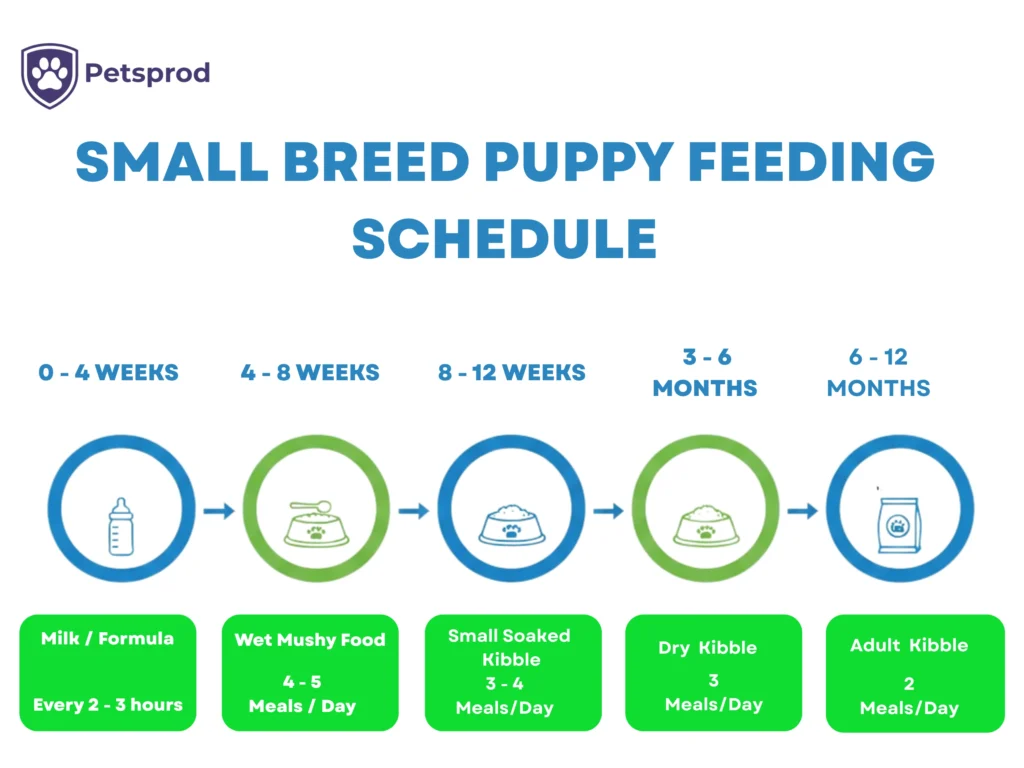
0 to 4 Weeks ( This Is Mom’s Job)
If the mother is present and healthy, your role at this stage is mostly observation. Puppies nurse every two to three hours, and maternal milk provides everything they need: the right proteins, the right fats, and the antibodies that build their early immune system. If the litter is orphaned, a quality puppy milk replacer with a bottle or dropper is the substitute. Never feed cow’s milk; the protein and fat ratios are completely wrong for puppies, and it causes digestive distress almost immediately.
4 to 8 Weeks (The Weaning Window)
This is where your involvement increases. Four to five meals per day, introduced gradually as puppy mush, dry kibble soaked in warm water until it reaches a soft, oatmeal-like consistency. Not soup, not dry crumbles. Something in between those tiny mouths and undeveloped teeth can actually manage. The transition from nursing to solid food should happen over two to three weeks, not overnight. Rushing this phase almost always results in digestive upset.
- Watch stool consistency and energy levels
- Gradually reduce the mush texture and introduce dry kibble slowly.
Most small breed puppies do best when fed three to four times daily, as their tiny stomachs cannot hold large amounts of food at once.” (Purina Nutritionists)
8 to 12 Weeks ( New Home, Peak Stress)
Three to four meals per day, and for toy breeds, learning how often to feed a puppy by age is genuinely the safer choice, especially in those first weeks home. This window matters more than most owners realise because it’s usually when puppies arrive in their new home. A new environment means new smells, new sounds, new routines, and that stress spikes cortisol, which burns through blood glucose faster than normal. The first week home is actually when hypoglycemia risk is at its highest. Keep the feeding schedule consistent from day one, even when everything else feels chaotic.
- Meals should ideally be spaced evenly, e.g., 8 am, 12 am, 4 pm, 8 pm for 4 meals.
- Use a bottle, dropper, or automatic feeder for midday meals if you are away.
3 to 6 Months (Building the Routine)
Three meals a day: morning, midday, and evening. Growth is still happening rapidly, but the metabolic picture is slightly more stable than those early weeks. This is also the stage where a consistent schedule starts paying off in unexpected ways. Regular meal times create a predictable digestive rhythm, which makes housebreaking noticeably easier. If you work outside the home during the day, the midday meal genuinely matters here, whether that’s a dog sitter, a trusted neighbor, or a quality automatic feeder.
6 to 12 Months (Two Meals, From Here On)
Two meals a day, morning and evening, ideally eight to twelve hours apart. The liver’s glycogen storage capacity has developed enough that longer gaps between meals are now safe. What doesn’t change, even after your small breed reaches full adulthood, is the two-meal structure. One meal a day is not appropriate for small breeds at any life stage — their metabolism simply doesn’t support it.
Feeding Schedule by Age
| Age | Meals Per Day | Notes |
|---|---|---|
| 0–4 weeks | Every 2–3 hours | Mom's milk or puppy milk replacer never cow's milk |
| 4–8 weeks | 4–5 per day | Puppy mush kibble soaked to oatmeal consistency |
| 8–12 weeks | 3–4 per day | Toy breeds: stay at 4–5 until 5 months |
| 3–6 months | 3 per day | Morning, midday, evening consistency is key |
| 6–12 months | 2 per day | Never drop to 1 meal small breeds need 2 for life |
Following this timeline ensures your puppy’s energy, growth, and blood sugar remain stable, turning a stressful feeding routine into a simple daily habit. If you have a mixed-age household or are still figuring out the basics, our full breakdown of how often a puppy should be fed walks through every stage in even more detail, including what changes and why as puppies grow.
The age-by-age table above gives you the quick version, but the puppy feeding schedule by age guide goes deeper — covering transition windows, signs your puppy is ready to drop a meal, and how breed size affects timing beyond just small versus large.
How Much Should You Feed? Portions Without Guesswork
Determining the right portion for a small breed puppy depends on a balance of their current weight, age, and activity level. Generally, most small puppies require between 1/4 and 1 cup of food per day, but this amount varies significantly between different food brands. The most reliable approach is to start with a baseline amount and adjust by 10% weekly based on your puppy’s physical growth and energy levels.
The Starting Point: Food Labels & AAFCO Compliance
Every bag of commercial puppy food has a feeding guide printed on it, and that’s exactly where you should start. Not because it’s perfect, but because it’s calibrated to that specific food’s calorie density and your puppy’s current weight. Think of it less like a prescription and more like a recipe suggestion. It gives you the right starting point, but you’ll still need to taste and adjust based on what you actually see.
One thing worth checking before anything else: look for the AAFCO statement on the packaging. It should say “complete and balanced for growth” or “for all life stages.” If that statement isn’t there, the food hasn’t met the minimum nutritional standards for a growing puppy. Most major brands like Purina provide a detailed puppy feeding chart by weight that serves as a reliable starting point before fine-tuning portions. Put it back and find one that has. That one line on the label does a lot of quiet work.
From there, treat the label’s suggested amount as your draft portion. Your puppy’s actual needs can vary by 20 to 50 per cent depending on how active they are, how warm or cold their environment is, and their individual metabolism. A puppy that spends the day running circles around your living room needs more than one that mostly naps. Adjust from the label baseline, don’t treat it as the final word.
Doing the Math: The RER Formula Made Simple
When the label isn’t giving you clear enough answers, there’s a more precise way to figure out exactly how many calories your puppy needs. Veterinarians use something called the Resting Energy Requirement RER for short.
What is RER?
Resting Energy Requirement (RER) is the minimum number of calories a puppy needs each day just to keep their body functioning at rest.
It does not include play, growth, or activity; those are added afterward using life stage multipliers.
Using a puppy’s Resting Energy Requirement (RER) is one of the most accurate ways to calculate daily calorie needs — particularly for small breeds who burn energy more quickly than larger dogs.” ( Pawlicy Advisor )
The formula looks like this:
RER = 70 × (body weight in kg)^0.75
Then you multiply that number by a life stage factor:
- Under 4 months: multiply by 3.0
- 4 to 12 months: multiply by 2.0
So a 3-pound puppy that’s roughly 1.36 kg at 10 weeks old would look like this: 70 × (1.36)^0.75 ≈ 88 kcal, then multiplied by 3.0 = 264 kcal per day. If the math feels like too much right now, our how much should I Feed My Puppy guide breaks it down into plain portion sizes by weight and age, no formula required.
Once you have that daily calorie target, look at the kcal per cup listed on your food bag and divide accordingly. Split that total across however many meals your puppy is having that day, and you have your per-meal portion. You don’t need to run this calculation every week. But knowing it exists means that if the label amount isn’t working, your puppy is gaining too fast or not gaining enough, you have an actual number to work from rather than just guessing in both directions.
Why a Kitchen Scale Beats a Measuring Cup Every Time
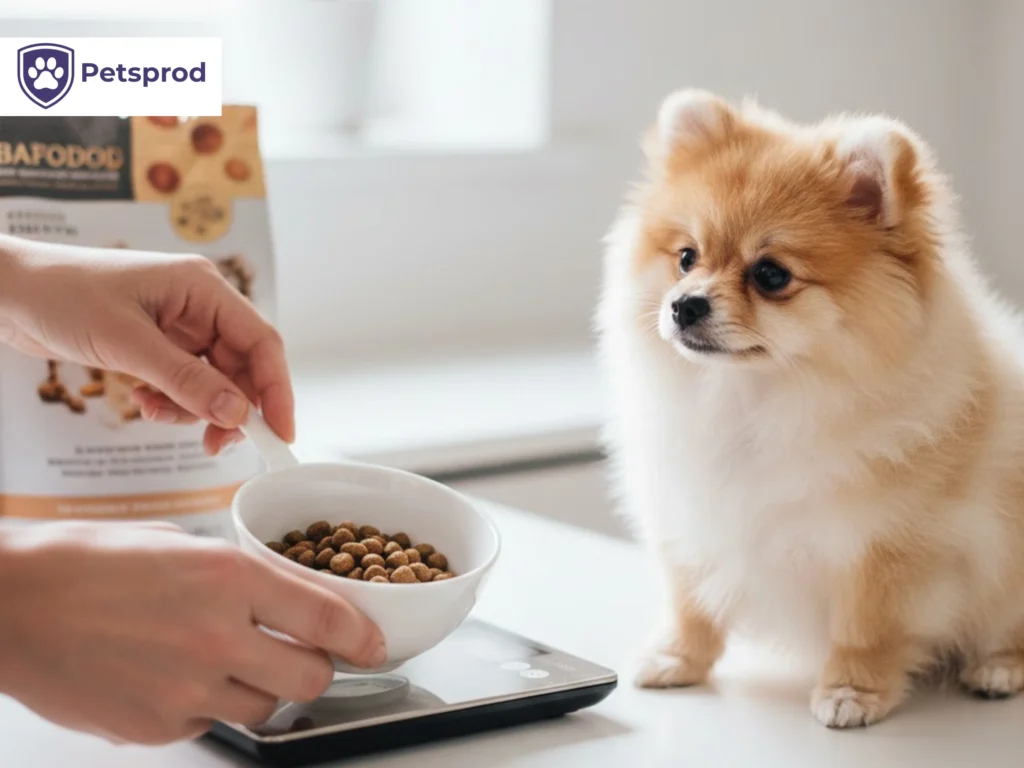
Here’s something nobody really talks about: measuring cups are surprisingly inaccurate when you’re dealing with very small quantities of food. When your puppy’s entire daily intake is somewhere between a quarter cup and half a cup, a slightly heaped scoop or a loosely filled cup creates a meaningful calorie difference. Kibble pieces don’t pack uniformly; different shapes, different densities, and different sizes all affect how much actually fits in a cup. Over days and weeks, that small inconsistency adds up.
A kitchen scale removes that variable entirely. Weigh the food in grams, hit the same number every meal, and you know exactly what your puppy is getting. It takes no extra time once it becomes a habit, and for toy breeds eating tiny amounts, it genuinely changes how precisely you can manage their nutrition.
A basic kitchen scale costs next to nothing. For a puppy whose entire daily food fits comfortably in the palm of one hand, it’s one of the most practical things you can buy.
The 10% Adjustment Principle
Whether you’re mixing wet and dry food or adjusting portions as your puppy grows, the 10 percent rule keeps things simple and safe.
If you’re combining wet and dry food, which is completely fine and often a good idea for picky eaters or puppies who need more hydration, calculate the calories coming from both sources combined. Don’t just add wet food on top of the dry portion without accounting for those extra calories. Reduce the dry amount proportionally so the total daily calorie count stays consistent.
When your puppy’s weight or body condition tells you something needs to change, move in 10 percent increments and then wait a full week before reassessing. Gaining too fast? Reduce by 10 percent. Not gaining enough or losing weight? Increase by 10 percent. One change at a time, one week at a time. Adjusting daily based on what you see that morning leads to a moving target that never settles give any change enough time to actually show results before you touch it again.
What to Feed a Small Breed Puppy
The quality of a puppy’s diet is just as important as the quantity. Small breed puppies require nutrient-dense formulas with smaller kibble sizes to accommodate their tiny mouths and high energy demands. Focus on high-quality animal proteins, essential fatty acids like DHA for brain development, and a precise balance of minerals to ensure healthy skeletal growth.

Small Breed Formula vs. Regular Puppy Food
Grabbing any bag labeled “puppy food” is an easy mistake but for small breeds, the difference between a small breed formula and a generic one shows up quickly in energy, coat, and growth.
Small breed formulas are built for three things: higher calorie density per cup so every small bite carries more fuel, smaller kibble size that fits tiny mouths and protects developing teeth, and higher nutrient concentrations to match a faster metabolism. A small breed puppy eating a regular formula in the “correct volume” may still be underpowered. It’s not a marketing difference, it’s an engineering one.
Reading the Label: The First Ingredient Rule
The ingredient list runs highest to lowest by weight. That first ingredient should always be a named animal protein: chicken, beef, lamb, salmon, or turkey. Specific, identifiable, traceable.
Watch out for “meat meal,” “poultry by-product,” or “animal fat” near the top. They’re vague; you can’t tell the source, quality, or processing method. Named proteins give you clarity. Unnamed ones don’t. Also, ensure the food meets AAFCO puppy nutrient profiles to guarantee it is complete and balanced for the growth stage.
If you’d rather skip the label-reading entirely, our roundup of the best puppy food UK for 2026 covers seven vet-approved options with small breed suitability scores already checked for you.
Brain & Bone Health: DHA and Minerals
DHA from fish oil builds brain tissue and retinal function during the fastest neurological growth window your puppy will ever have. Puppies on DHA-supplemented diets show measurably better cognitive function and vision. Look for fish oil or salmon oil in the ingredients, as fish oil for puppy brain development is a critical factor in early learning.
Calcium and phosphorus ratio matters equally. The ideal ratio is between 1:1 and 2:1. This is exactly why homemade puppy diets without vet guidance carry real risk. The ratio is easy to get wrong without realizing it, leading to permanent skeletal issues.
Red Flags: Ingredients to Avoid
-
Xylitol: An artificial sweetener found in some peanut butters. Even tiny amounts cause a rapid blood sugar crash.
-
Corn syrup and added sugars: These provide no nutritional value and spike blood glucose dangerously.
-
Artificial colors: Red 40, Yellow 5, and Blue 2 only exist to appeal to humans, not dogs.
-
Unnamed fat sources: “Animal fat” with no species listed is unverifiable in quality.
-
Carrageenan in wet food: Linked to digestive inflammation in some studies.
If you can’t trace where a protein or fat came from on the label, that’s your answer. Choosing the right food isn’t about fancy packaging or marketing claims. Focus on small breed engineering, named proteins, brain/bone nutrients, and avoiding red flags, and you’ll set your puppy up for growth and health from day one.
Scheduled Feeding vs. Free Feeding
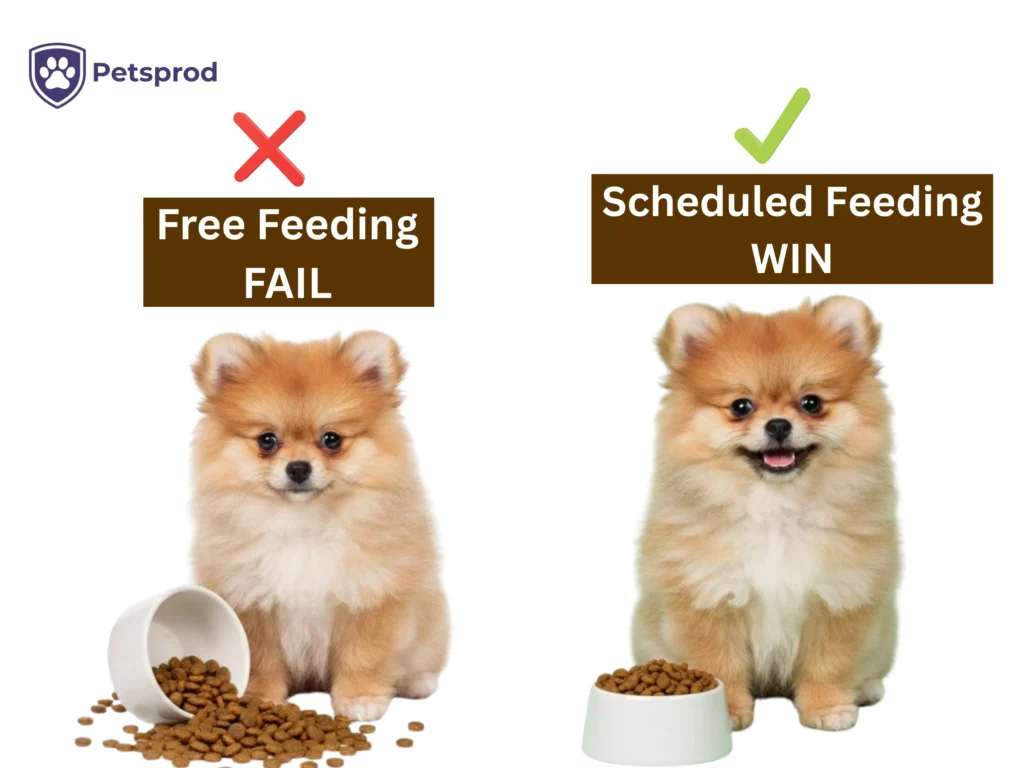
Establishing a consistent feeding schedule is one of the most effective ways to manage a small breed puppy’s health and behavior. While free feeding may seem convenient, a structured routine provides critical insights into your puppy’s appetite, ensures they maintain stable blood sugar levels, and significantly accelerates the housebreaking process by creating a predictable digestive rhythm.
Why Free Feeding Fails Small Breeds
Free feeding sounds convenient: food stays out, puppy eats when hungry. For small breeds, it creates two real problems.
- First, you lose your appetite signal. A puppy eating less is usually the earliest sign that something is wrong. With food available all day, you simply can’t see that change.
- Second, small breeds don’t always self-regulate. Some eat everything at once, some graze unpredictably. Either way, you lose track of exactly what’s going in and at half a cup a day, that matters for their long-term weight management.
The Benefits of a Strict Schedule
Scheduled feeding creates predictability, and for small breeds, predictability is everything. It offers three distinct advantages:
Illness detection:
A skipped meal stands out right away when you’re feeding at set times. You catch appetite changes early, before anything else appears.
Housebreaking:
Consistent meals create consistent digestion. Predictable eating means predictable bathroom timing. Most owners notice the difference within the first week of a strict schedule.
Weight management:
Measured portions mean you always know exactly what’s going on. For small breeds where small excesses add up fast, that control is genuinely valuable.
The 20-Minute Rule & Treat Math
The rule is simple, and it works faster than most people expect. Put the bowl down, set a timer, and remove the bowl after 20 to 30 minutes. Whatever’s left is gone until the next meal. Most puppies adjust to this rhythm within just a few days.
For treats, you must be disciplined with the numbers. A 260-calorie puppy has a daily “fun” budget of only about 26 calories. Treat calories should never exceed 10% daily intake. Exceeding this regularly can disturb balanced nutrition and cause hidden weight gain. Since many commercial treats range from 15 to 40 calories, a single snack can blow the entire budget.
The best solution
is to use healthy training treats or even pieces of their regular kibble as rewards. Same signal, zero extra calories. If you do use purchased treats, break them into pea-sized pieces; the enthusiasm stays, but the calories don’t add up.
Structure creates clarity. And clarity is what keeps a small-breed puppy healthy, lean, and predictable as they grow. If your puppy still seems ravenous between meals despite a solid schedule, it’s worth understanding why some puppies always seem hungry because sometimes it’s behaviour, and sometimes it’s a portion issue worth revisiting.
How to Know If Your Feeding Plan Is Working
Monitoring your puppy’s physical progress is the only way to ensure your feeding plan stays on track. By using simple weekly weigh-ins, checking stool quality, and performing a “rib test,” you can catch nutritional gaps or overfeeding before they become health issues. Consistency in monitoring is just as important as consistency in feeding.

The Rib Test & Body Condition Score
Run your fingers gently along both sides of your puppy’s ribcage. You should feel each rib without pressing hard, but they shouldn’t be visibly prominent from across the room. From above, there should be a visible waistline narrowing between the ribs and hips. From the side, a slight upward belly tuck toward the hind legs.
This is called the Body Condition Score. Vets use a 9-point scale where 4 to 5 is ideal for a growing puppy. Score 3 or lower means underfed. Score 6 or higher means overfed. You don’t need the chart to use it; your hands give you the same answer. Think of it like feeling car keys through a jacket pocket. Present, but not obvious.
Weekly Weigh-ins & Stool Quality
Weigh your puppy once a week, same time, same scale. Step on holding your puppy, note the number, and subtract your own weight. A healthy small breed puppy gains roughly 5 to 10 per cent of their body weight per week during active growth. Flat weight or loss for two consecutive weeks is a signal to call your vet.
Stool quality is your daily report card. Ideal stools are firm, moist, and log-shaped. They hold their shape and are easy to pick up. Poop consistency as a health signal is one of the most reliable ways to judge digestion. Soft or shapeless stools usually mean overfeeding or a food transition happening too fast. In more serious cases, overfeeding can affect the gut lining directly, something worth understanding before it becomes a bigger problem.
Signs of Overfeeding vs. Underfeeding
These are:
Overfeeding signs:
-
- No visible waist from the above body looks cylindrical.
- Soft, large-volume, or frequent stools.
- Low energy and reluctance to play.
- Weekly weight gain consistently above 10 per cent.
-
Underfeeding signs:
- Ribs are visible from a distance without touching.
- Constant restlessness or crying between meals.
- Dull, dry, or flaking coat.
- Trembling, glassy eyes, or a wobbly walk, this may be hypoglycemia. If you see trembling or a wobbly walk together, rub honey or Karo syrup on the gums immediately and call your vet.
Conclusion
The confusion you felt on day one, scoop in hand, puppy staring up, doesn’t last long once you understand what’s actually happening inside that tiny body.
Small meals, the right food, and a consistent schedule are the foundation of a healthy life. It becomes second nature faster than you’d expect, and the results show up quickly in energy levels, coat condition, and steady growth. A reliable feeding routine is the best gift you can give your new companion.
FAQs
How often should I feed a 3-month-old small breed puppy?
At 3 months, three meals a day, morning, midday, and evening. Toy breeds like Chihuahuas may still need four meals at this age to keep blood sugar stable.
When should I switch my small-breed puppy to adult food?
Most small breeds are ready at 9 to 12 months once they reach 90% of their adult size. Always transition gradually over 7 days to avoid digestive upset.
Is free feeding safe for small-breed puppies?
Not recommended. You lose the ability to monitor appetite, which is the earliest signal of illness, and it makes housebreaking much harder.
Can I feed my small-breed puppy large-breed food?
No. Large breed food has lower calorie density. A small breed puppy eating large breed food will likely be under-fueled and lack the nutrients required for their fast metabolism.