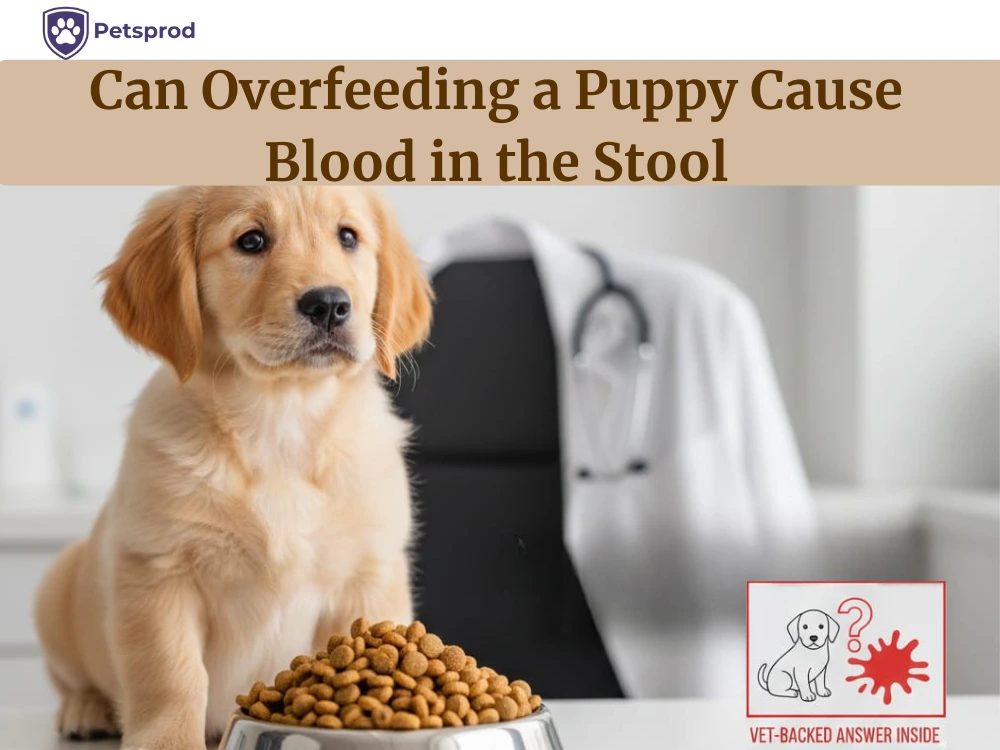
Can Overfeeding a Puppy Cause Blood in Stool? Yes, and it happens more often than most dog owners realize. We’ve all been there—those innocent puppy eyes staring you down during dinner, and before you know it, you’ve shared “just one more bite.” But when you wake up the next morning to find a spot of blood in their stool, it’s natural to spiral into a panic.
If your puppy is still active, playful, and eating normally, this is often just a mild digestive reaction- known as “dietary indiscretion”, where excess food irritates the intestines rather than causing a serious illness.
What matters more than the stool itself is your puppy’s overall energy—lethargy or refusal to eat is a red flag, while playful behavior usually points to a mild issue like overfeeding.
The reality is that many pet owners struggle with portion control. We often “eyeball” the kibble or add a little extra “just in case,” not realizing how delicate a puppy’s gut truly is. But sticking to a proper puppy feeding schedule by age can prevent these digestive flare-ups. Moreover, understanding how often a puppy should be fed throughout the day ensures their system isn’t hit with too much food at once.
In this guide, we’ll break down why this happens and how to get their digestion back on track.
Why Too Much Food Causes Bloody Stool: The Science Behind the Bleeding
Overfeeding doesn’t just cause a full belly – it changes how a puppy’s digestive system works. When a puppy eats too much, their gut can’t process all the food. This causes stress and irritation in the intestines.
1. Mechanical Pressure on the Intestinal Lining
Think of a puppy’s intestinal lining (the intestinal mucosa) as extremely delicate tissue. When a puppy is overfed, the sheer volume of food creates high pressure inside the intestines. In medical terms, this increase is known as luminal pressure.
This pressure causes the intestinal walls to stretch beyond their normal capacity. As they stretch, the tiny blood vessels (capillaries) embedded in the lining can leak or rupture. This results in fresh, bright red blood appearing on the surface of the stool.
2. Bacterial Overgrowth: The “Clostridium” Factor
When a puppy consumes more food than their enzymes can break down, the undigested leftovers sit in the lower intestine. This creates a breeding ground for bacteria, specifically Clostridium perfringens.
As these bacteria feed on the undigested nutrients, they multiply rapidly and release toxins. These toxins cause inflammation and irritation in the colon, further contributing to the presence of blood and mucus in the stool.
3. Understanding Hematochezia (Bright Red Blood)
In veterinary medicine, seeing bright red blood in a dog’s stool is called Hematochezia. This usually indicates irritation or bleeding in the lower digestive tract, such as the colon or rectum. This is actually a diagnostic clue:
-
Bright Red Blood
Indicates the irritation is in the lower digestive tract (colon or rectum). This is typical for overfeeding or minor irritation.
-
Dark, Tar-like Stool (Melena)
Indicates bleeding higher up in the stomach or small intestine, which is often more serious.
Because overfeeding usually irritates the lower tract, the blood appears fresh. The good news is that since the irritation is localized and recent, it often resolves quickly once the feeding schedule is corrected.
The Genetic Secret: Why Some Puppies Never Feel Full
Ever wonder why some puppies—especially Golden Retrievers and Labradors—act as if they haven’t eaten in days? You might have filled their bowl ten minutes ago, but they’re already back, staring at you with those soul-piercing “I’m starving” eyes.
The truth is, it’s not just dramatics. For many breeds, it’s actually hardwired into their DNA.
The “Always Hungry” Labradors (The POMC Gene Mutation)
A fascinating study from the University of Cambridge found that a significant number of Labradors carry a specific genetic tweak called the POMC gene mutation. In a healthy dog, this gene is responsible for sending a signal to the brain saying, “The stomach is full, you can stop eating now.”
However, when this gene is mutated, that signal never makes it through. The brain essentially misses the “memo” that the body has had enough food.
This creates a dangerous cycle. Your puppy is genuinely convinced they are starving, even with a full belly. As a loving owner, it’s incredibly hard to resist those pleading eyes. But when we cave and give them “just a little more,” we run into the exact problem we’ve been discussing: overfeeding causing blood in the stool. When the brain doesn’t register “full,” the stomach keeps expanding, putting immense pressure on the intestinal lining until it begins to bleed.
The Greediness Gene: Brain vs. Belly
It’s not just Labs; Golden Retrievers are often victims of this “Greediness Gene” as well.
The biological disconnect is real: their stomach is physically stretched to capacity, but their brain is still screaming for more. This is why your puppy might circle their empty bowl or sniff around sniffing.
Owner Tip: “It’s Not Hunger, It’s DNA”
Many owners feel guilty, wondering if they are underfeeding their pets. Let’s clear that up right now: It’s not hunger; it’s DNA.
To protect your puppy from their own genetic drive to overeat, you have to be the disciplined one. You must ignore those “sad eyes” and stick to a professional feeding plan.
1.Don’t Eyeball It
Make sure you know exactly how much you should be feeding your puppy based on their weight and breed. Use a measuring cup every single time.
2.Stick to a Schedule
Establish a strict puppy feeding schedule and follow it religiously. No “just this once” treats.
Trust the schedule, not the stare. Your puppy’s long-term gut health depends on your ability to say no in the kitchen immediately after a meal. It’s not a sign of hunger—it’s a sign of their internal wiring misfiring.
Comparison Guide: Overfeeding vs. Serious Illness
When you see blood in your puppy’s stool, it’s natural for your mind to jump to the worst-case scenario. Is this just the result of too many treats, or are you dealing with something as serious as Parvo? The anxiety is real, but understanding the clinical signs can help you stay calm and take the right action.
Quick Difference at a Glance
Table
| What to Check | Overfeeding (Dietary Indiscretion) | Parvo / AHDS (Serious Illness) |
|---|---|---|
| Blood Color | Bright red streaks (Fresh) | Dark, tarry, or foul-smelling |
| Energy Level | Active, playful, and alert | Lethargic—refusing to move or play |
| Appetite | Still hungry and begging for food | Refusing both food and water |
| Vomiting | Occasional or none at all | Persistent and severe vomiting |
| Temperature | Normal (101°F–102.5°F) | High fever or dangerously low |
The PCV Marker: How Vets Actually Check (Expert Insight)
To evaluate a puppy’s overall blood health, vets commonly perform a Complete Blood Count (CBC) test. This test measures red blood cells and packed cell volume (PCV), helping vets assess whether bleeding, anemia, or other blood abnormalities are present.
The PCV (Packed Cell Volume) test is the most accurate way vets diagnose the severity of a situation.
When a puppy arrives at the clinic with bloody diarrhea, a vet will immediately check the puppy’s PCV to see what percentage of the blood is made up of red blood cells.
-
The Overfeeding Scenario:
If the issue is just an overloaded gut, the PCV usually comes back normal. This is because the puppy isn’t dehydrated; their system is irritated, but they are still absorbing fluids correctly.
-
Serious Illness (AHDS/Parvo):
In cases like AHDS (Acute Hemorrhagic Diarrhea Syndrome), the PCV can spike past 60%. This is a major red flag. It means the blood has become dangerously thick due to rapid fluid loss. In this situation, your puppy needs IV fluids (a drip) immediately to stabilize.
Expert Note:
In clinical terms, a healthy puppy typically has a normal PCV range of 35% to 55%. When the value climbs toward or exceeds 60%, it indicates severe hemoconcentration (thickening of the blood), which is a hallmark sign of serious conditions like AHDS or Parvo.
Why This Matters for Your Daily Routine
This diagnostic reality is why sticking to a consistent puppy feeding schedule is so important. It’s not just about discipline; it’s about preventing “gut-wrenching” situations that lead to medical emergencies.
If your puppy is acting fine and the vet confirms a normal PCV, the solution is usually simple: tighten up on portion control and follow the exact guidelines we’ve outlined in our puppy feeding guide. No expensive medications—just better meal management and knowing how often to feed your puppy to keep their digestion smooth.
Management: The 24-Hour Recovery Plan
If you have confirmed that your puppy is acting like their usual energetic self and the blood in their stool is simply a result of overfeeding, you can manage the situation at home. The goal is to give that irritated digestive system a chance to rest and heal.
Follow this step-by-step recovery guide.
Step 1: The Fast (Gut Rest)
The first step in managing your puppy’s recovery is to pause all solid food for at least 12 hours.
It might feel harsh to deny those hungry eyes, but here is why vets recommend it:
Expert-Backed Reason:
When a puppy overeats, their intestines stretch like an over-inflated balloon, causing tiny blood vessels to rupture. If you keep feeding them, you are essentially “scraping” an already wounded area. By giving the gut a 12-hour break—no kibble, no treats, no scraps—the intestines finally get the time they need to reduce inflammation and stop the bleeding.
Important:
Never restrict water. Your puppy must have access to fresh water 24/7 to stay hydrated while their gut rests.
Step 2: The 50/50 Bland Diet
Once 12 hours have passed, and the blood has slowed or stopped, do not go straight back to heavy kibble. Your puppy’s digestive system has been through a lot of stress, so you need to ease them back in with a Bland Diet.
Use this specific 50/50 ratio:
-
50% Boiled Chicken:
Use skinless, boneless chicken. Boil it in plain water with no salt, spices, or oils. Shred it into small pieces. It’s a gentle, easy-to-digest protein.
-
50% White Rice:
Plain boiled white rice acts as a “binding agent,” helping to firm up the stool and soothe the gut.
This combo is soft enough to pass through the intestines without causing further mechanical irritation.
Pro Tip:
Even with a bland diet, do not overfeed! Portion control is what started this, so make sure you check exactly how much you should be feeding your puppy to avoid another flare-up.
The Transition: Getting Back to Normal
Usually, a bland diet is needed for 2 to 3 days. Once the stool is solid and blood-free, don’t just switch back to kibble overnight. A sudden change can shock the system all over again.
Follow this gradual transition:
| Day | Bland Diet Amount | Regular Kibble Amount |
|---|---|---|
| Day 1 | 75% | 25% |
| Day 2 | 50% | 50% |
| Day 3 | 25% | 75% |
Day 1:
75% Bland Diet + 25% Regular Kibble
Day 2:
50% Bland Diet + 50% Regular Kibble
Day 3:
25% Bland Diet + 75% Regular Kibble
Day 4:
100% Regular Kibble
To prevent this from happening again, make sure you stick to a consistent puppy feeding schedule and understand how often a puppy should be fed throughout the day.
Long-Term Prevention: Breaking the Cycle
Seeing blood in your puppy’s stool is a terrifying experience. I get it. But if you want to prevent this from happening again, you have to move away from the “guessing game” and start being precise with their nutrition.
No more “eyeballing” the bowl. Here is how you protect your puppy’s gut health for the long term.
1.Precision Tools: Measuring Cups vs. “Estimation.”
Most owners grab a handful of kibble or fill the bowl to a certain level and call it “close enough.”
With puppies, even 10-20 grams of extra food can overwhelm their sensitive digestive system. Their guts are incredibly delicate. The solution is simple: use a proper measuring cup for every single meal. When you know the exact amount you’re feeding, you completely eliminate the risk of mechanical stretching. No stretched intestines means no ruptured capillaries and no blood.
2.Frequency Over Volume: The Magic of Small Meals
Think about it: a puppy’s stomach is roughly the size of a walnut. Imagine cramming an entire day’s worth of nutrients into that tiny space at once.
Instead, split their daily intake into 3 to 4 smaller meals. This ensures the intestines don’t get overwhelmed, and food moves through smoothly without causing the pressure buildup that leads to bleeding. To get the timing right, check out our guide on how often a puppy should be fed for optimal growth.
3.Age-Specific Discipline3
Puppies grow fast, and their digestive capacity changes just as quickly. The feeding schedule that worked at 8 weeks will be completely wrong by the time they hit 4 months.
To stay on track, you must adjust their intake as they evolve. Following a dedicated puppy feeding schedule by age doesn’t just prevent bloody stools—it also protects your puppy from obesity, bloating, and growth-related issues.
How to Treat Overfeeding at Home: Step-by-Step Recovery
If your puppy is still acting like their usual energetic self—playing and wagging their tail—despite a small amount of blood in their stool, you can likely manage the recovery at home. Here is exactly how to reset their digestive system:
1. Stop Feeding (The 12-Hour Fast)
The first move is to remove the food bowl. For a full 12 hours, do not offer any solid food.
It might feel difficult when they give you those pleading eyes, but remember: their intestines are currently inflamed. Every bite of food added now just continues the mechanical irritation. A 12-hour break allows the gut to calm down and the healing process to begin.
2. Hydration is Critical
While food is off-limits, water must always be available. Keep the bowl full and accessible at all times.
Pro Tip: You can also offer Rice Water (the starchy water left over from boiling white rice). It is incredibly gentle and can help soothe the gut lining. Just ensure it has cooled down to room temperature before serving.
3. The 50/50 Bland Diet
After the 12-hour fast, do not return to regular kibble immediately. Instead, feed a bland diet for 2–3 days:
- 50% plain boiled chicken: No seasoning, no oil, no skin.
- 50% plain white rice: Well-boiled and soft.
This combination is easy to digest and won’t put strain on the recovering intestines. It’s simple, but it’s exactly what their system needs to stabilize.
When to Call the Vet: Red Alert Signs
Not every case of bloody stool is a “wait and see” situation. If you notice any of the following Red Flags, stop the home treatment and contact your vet immediately:
Lethargy:
If your puppy is lying still, has no interest in playing, or seems unusually weak. Simple overfeeding doesn’t cause a total collapse in energy.
Projectile Vomiting:
If they cannot keep water down and are vomiting repeatedly and violently.
Profuse Bleeding:
A thin red streak is one thing, but if you see thick clots, heavy mucus, or a significant volume of blood, it’s a medical emergency.
Sunken Eyes:
This is a sign of severe dehydration. Check their gums; if they are dry and tacky instead of wet and slippery, your pup needs IV fluids.
The 24-Hour Rule:
If you have followed the home recovery plan perfectly but the bleeding persists after 24 hours, do not wait any longer. Seek professional help.
Conclusion
Look, seeing blood in your puppy’s stool is terrifying. But if they’re still playing, eating, and acting like their usual goofy self? You’re likely just dealing with the aftermath of overfeeding, not a life-threatening emergency.
The fix is straightforward: a 12-hour fast, a bland diet of chicken and rice for a few days, and a commitment to actually measuring their food going forward. Your puppy doesn’t need a heaping bowl to feel loved—they need consistency, playtime, and a solid feeding routine.
Stick to the plan. Trust your instincts. And if things don’t improve within 24 hours or your pup suddenly becomes lethargic, get them to a vet immediately.
FAQs
Can overfeeding actually kill a puppy?
Rarely, but yes—through a condition called bloat (GDV), where the stomach twists after overfilling. If your pup’s belly is rock-hard, they’re trying to vomit but can’t, or they’re in obvious distress, get to a vet immediately. It’s a true emergency.
How long should I keep my puppy on the bland diet?
Two to three days, max. Once the stool’s back to normal, transition slowly back to regular food over another 3-4 days. Don’t rush it or you’ll be right back where you started.
How do I count treats, so I don’t accidentally overfeed?
Follow the 10% rule: treats should be no more than 10% of daily calories. If you’re training heavily with treats, reduce their main meals by the same amount. Most treats are calorie-dense, so those “just one more” moments add up fast.