
Can puppies eat raw food? Yes, and honestly, more puppies thrive on it than most people expect. A properly balanced raw diet supports stronger gut health, leaner growth and better coat condition from the very first weeks of life. But get the balance wrong and the consequences are serious. Permanent skeletal damage, bacterial infection in your home and a very unwell puppy are not worst case scenarios. They are documented outcomes.
The Food Standards Agency surveyed raw pet food products sold across the UK and found that 35% tested positive for harmful bacteria, including Salmonella and E. coli. That number is not there to scare you off raw feeding. It is there because understanding the risks is exactly what separates owners who do this well from those who do not.
This guide covers the science, the real clinical risks vets actually see, breed specific differences and UK safety rules. Everything in one place, so you can make a proper, informed decision.
Always consult your vet before changing your puppy’s diet, especially if you have a large breed puppy or vulnerable people in your household.
When Can Puppies Safely Start Raw Food?

Most people assume raw feeding is something you introduce once a puppy is a few months old and properly settled in. It actually starts much earlier than that.
From birth to three weeks, mother’s milk is the only thing a puppy needs. The digestive system is simply not ready for anything else at this stage. Around three to four weeks, weaning begins, and this is where raw can come in. Fine minced raw chicken or rabbit in very small amounts works well alongside milk. Nothing chunky, nothing complex, just a gentle introduction to real food.
By seven to eight weeks, which is when most UK puppies arrive in their new homes, the majority are completely ready for a full raw diet from day one. The one rule worth following here is sticking to a single protein for the first two weeks. Chicken or rabbit are both solid starting points. Introduce too much variety too soon and if any digestive issues come up, you will have no idea what caused them.
What Science Actually Proves About Raw Feeding
Raw feeding gets a lot of pushback from the veterinary world, and some of that is genuinely warranted. But the research picture has shifted quite a bit recently, and it is worth understanding what the studies actually say rather than going off secondhand opinions.
A large scale study from the University of Helsinki followed over 7,000 dogs across their lifespans and found that puppies fed a non-processed meat based diet during early life had a significantly lower risk of developing chronic gut conditions, including inflammatory bowel disease in adulthood. Puppies weaned onto highly processed kibble showed a noticeably higher risk of gastrointestinal problems later in life. One thing worth being clear about, though: this was an association study, not a controlled trial. The non-processed category included frozen raw, raw meaty bones, and home-cooked leftovers, not exclusively commercial raw food. The findings are meaningful, but they are not a green light to feed anything raw without thinking it through. University of Helsinki raw feeding study
On the digestibility side, raw protein sits at around 95% bioavailability compared to roughly 78% in some processed diets. High-temperature extrusion, which is the process behind kibble manufacturing, reduces the biological value of certain amino acids. Raw diets skip that process entirely.
Raw fed dogs also carry higher levels of short-chain fatty acids in their gut. These are produced by beneficial bacteria processing dietary protein, and they play a direct role in immune development and reducing intestinal inflammation. For a puppy whose immune system is still being built from scratch, that early microbiome foundation genuinely matters.
Real Risks Vets Actually See in Clinic
This is the part most raw feeding guides either skip over or bury at the bottom. The risks are real, they are documented, and understanding them properly is what makes the difference between safe raw feeding and a vet emergency.
The most common clinical harm seen in raw-fed puppies has nothing to do with bacteria. It comes from a calcium and phosphorus imbalance. Muscle meat is naturally high in phosphorus. Calcium comes primarily from raw edible bone. When puppies are fed exclusively boneless raw meat with no bone component, the body responds by pulling calcium from the puppy’s own developing skeleton to maintain blood levels. A peer-reviewed case series documented four large-breed puppies fed exclusively on boneless raw meat who developed exactly this condition within months. All four presented with bones so severely depleted they appeared translucent on X-ray. Pathological fractures followed, and in several cases, the skeletal damage was permanent even after the diet was corrected PMC clinical case series on raw fed puppies
Bacterial contamination is the second major concern and the one that affects your household as much as your puppy. The Food Standards Agency tested over 380 raw pet food products sold across the UK and found that 35% contained harmful bacteria, including Salmonella, Campylobacter and E. coli, with 29% failing UK legal safety standards outright. A healthy
puppy’s stomach acid neutralises most of these pathogens before they cause illness. The risk sits with the humans in the house, particularly anyone who is pregnant, elderly, very young or immunocompromised. FSA raw pet food survey results
There is also a growing concern around antimicrobial resistance that does not get nearly enough attention. Raw pet food has been confirmed as a transmission route for antibiotic-resistant bacteria. Raw fed dogs shed these strains in their faeces, where they can persist in the environment and transfer to humans through everyday contact with the dog.
If anyone in your household is pregnant, elderly or immunocompromised, speak to your vet before starting raw feeding.
BARF vs PMR: What Is the Actual Difference for Puppies?
If you have spent any time in UK raw feeding communities, you have almost certainly come across these two terms. They are the two main frameworks people follow, and both are valid for puppies when done correctly.
- BARF, which stands for Biologically Appropriate Raw Food, was developed by Australian vet Dr Ian Billinghurst. It treats the dog as a facultative carnivore that benefits from some plant material alongside animal protein. A BARF diet includes lightly blended vegetables for fibre and phytonutrients alongside muscle meat, raw edible bone and organs.
- PMR, or Prey Model Raw, takes a stricter approach. No plant material at all. The idea is to replicate the proportions of a whole prey animal as closely as possible using muscle meat, bone and organs only.
For puppies specifically, both models adjust the bone content upward during the skeletal mineralisation window. The table below shows how they compare.
| Model | Vegetables | Bone % for Puppies | Good For |
|---|---|---|---|
| BARF | Yes | 17% | Beginners |
| PMR | No | 17% | Experienced feeders |
The 17% bone figure applies to both models, and it does not change regardless of which framework you follow. This is the single most important number in puppy raw feeding because it directly governs calcium intake during the growth phase.
If the portion side feels unclear, this feeding guide makes it much easier to work out.
UK Raw Feeding Safety Rules
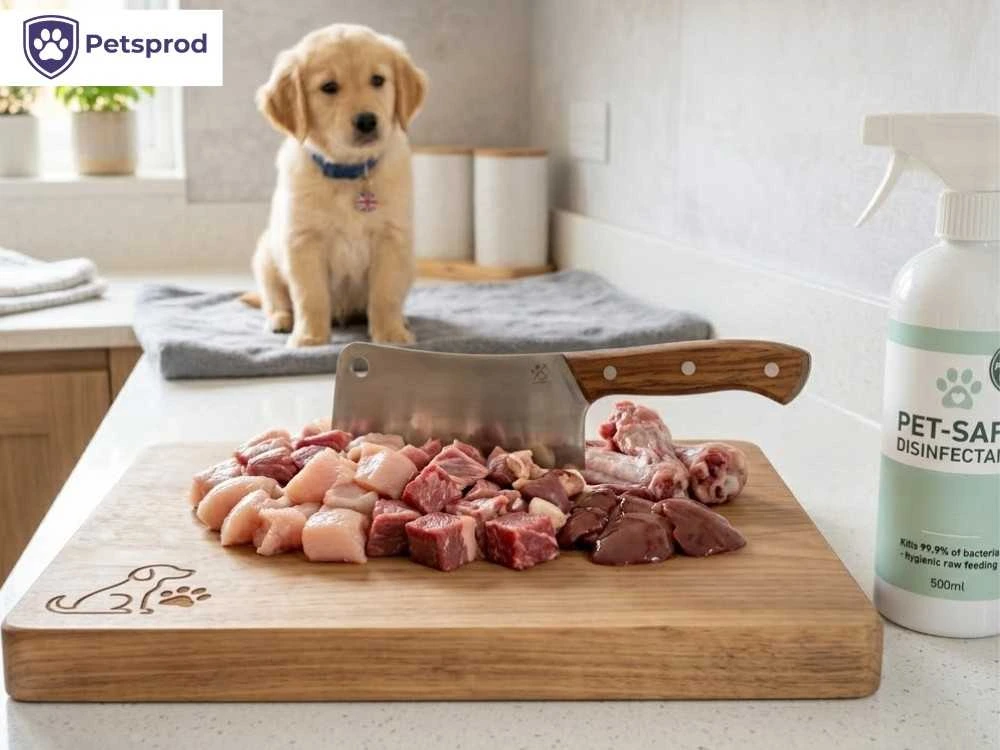
This is the part a lot of raw feeding guides gloss over, and it really should not be. Handling raw meat for your puppy carries the same food hygiene responsibilities as handling raw chicken for your own dinner. The bacteria involved are largely the same.
The Food Standards Agency sets the official standard for raw pet food handling in UK households. The core rules are straightforward. Always wash your hands immediately after handling raw pet food. Store it at the bottom of the fridge, sealed and completely separate from human food. Never defrost at room temperature; always overnight in the fridge. Use a dedicated chopping board and knife that never touches human food preparation. Clean and disinfect all surfaces, bowls and utensils after every single use FSA guidance official raw pet food handling.
For households with pregnant women, elderly members, young children or anyone immunocompromised, HPP raw is worth knowing about. High Pressure Processing uses extreme cold water pressure rather than heat to neutralise pathogens in raw pet food while keeping the nutritional profile of uncooked meat completely intact. It is the safest starting point for anyone in that situation.
The British Veterinary Association does not recommend raw feeding as standard practice, primarily because of the food safety risks involved. Their position does acknowledge though that a nutritionally balanced raw diet handled with proper hygiene is ultimately an owner’s decision. BVA official position on raw feeding
Always speak to your vet before starting, particularly if anyone in your household is pregnant, elderly or immunocompromised.
Large Breed vs Small Breed Raw Feeding Is Not the Same for Both

This is something a lot of first time raw feeders do not realise until something goes wrong. Breed size changes almost everything about how a raw diet needs to be structured for a growing puppy.
Large and giant breed puppies are genuinely the highest risk group in raw feeding. Their growth plates stay open until eighteen to twenty four months, far longer than smaller breeds. Overfeeding during this window drives rapid weight gain that puts direct mechanical stress on cartilage that has not fully mineralised yet. That is how hip dysplasia, elbow dysplasia and osteochondrosis develop. The target with large breeds is always lean, controlled, and slow growth. A large breed puppy that looks slightly lean is in a much safer position than one that looks well filled out.
For giant breeds specifically, Great Danes, Mastiffs and Irish Wolfhounds, standard body weight percentages are not precise enough to work with. These dogs need their daily portions calculated using the Resting Energy Requirement formula rather than a simple percentage of body weight. WSAVA nutrition guidelines
Small and toy breed puppies sit at the other end of the risk scale, but they come with their own specific concerns. Their metabolisms run significantly faster, and they reach adult size by around nine to ten months. The issue with toy breeds is meal frequency rather than portion size. Skipping even a single meal in a very young toy breed puppy can trigger hypoglycaemia. Four to five meals daily minimum until at least four months is the standard recommendation for this group.
Final Thoughts
Raw feeding works. Thousands of UK puppies thrive on it every single day. But it is not something you can approach casually, throw together without thinking and hope for the best. The puppies that do well on raw have owners who understood the balance before they started, not after something went wrong.
The two things that matter above everything else are nutritional balance and hygiene. Get those two right, and raw feeding gives your puppy a genuinely strong foundation to grow from. Get either one wrong, and the risks are real, documented and in some cases permanent.
If you are just starting out, keep it simple. Single protein, correct bone percentage, proper fridge storage and clean preparation every single time. Build from there.
And before you make any changes to your puppy’s diet, speak to your vet. Especially if you have a large breed puppy or anyone vulnerable in your household.
People Also Ask
Can an 8-week-old puppy eat raw bones?
Yes, but soft ones only. Chicken wing tips and small chicken necks are the right starting point. Hard weight bearing bones are not appropriate before twelve weeks and should always be given under supervision.
Is raw food safe for large breed puppies?
It can be, but large breeds need a properly formulated diet more than any other group. Calcium to phosphorus ratio and bone percentage are both critical. Always speak to a vet before starting.
BARF or PMR — which is better for puppies?
BARF is the easier starting point for most owners. The plant fibre supports gut motility, and the model is more forgiving while you are still learning. PMR works well, too, but requires more nutritional knowledge and variety across protein sources.
What are the hygiene rules for raw pet food in the UK?
FSA requires dedicated utensils, raw food stored at the bottom of the fridge away from human food, immediate handwashing after handling and full disinfection of surfaces and bowls after every use.
How do I prevent diarrhoea when switching to raw?
Single protein for the first two weeks. Transition gradually over seven days. Minor stool softening in the first few days is normal. If it continues beyond five days slow the transition and speak to your vet.